
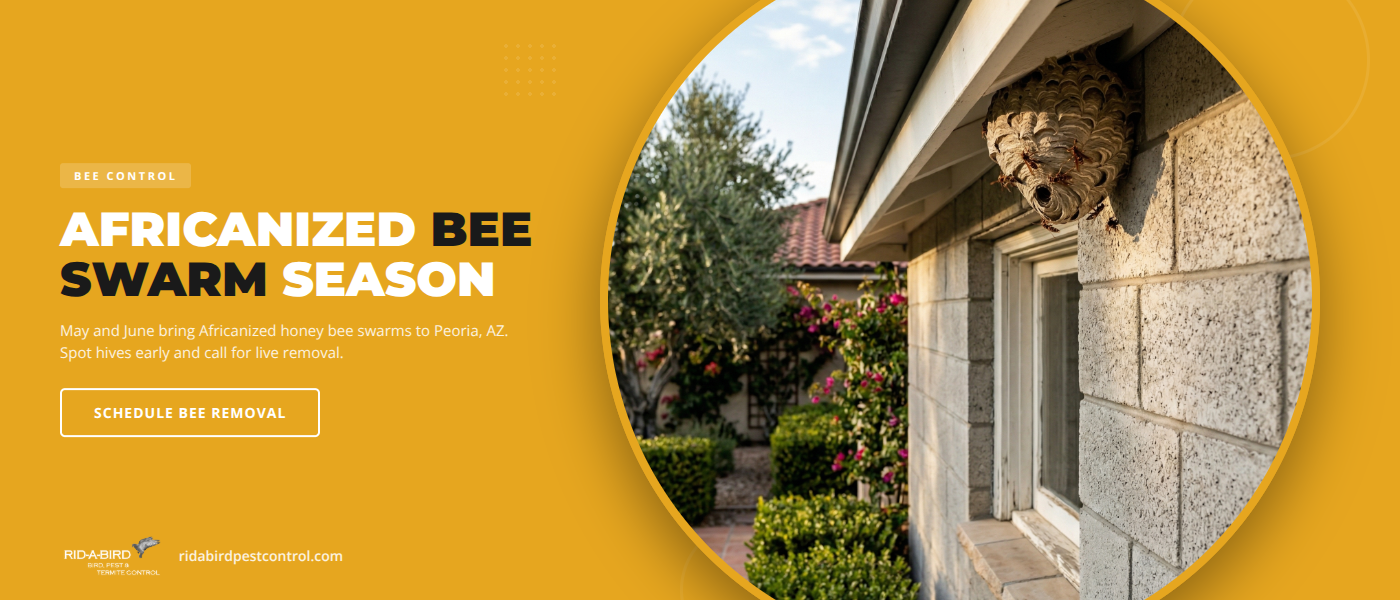
Most Peoria homeowners do not notice a bee swarm until it is already pulsing in a saguaro, a block wall vent, or hanging in a cluster the size of a football from a citrus tree. May and June are when those clusters show up across the West Valley, and almost every wild colony our team is called to in Peoria now traces back to Africanized honey bees. If you have spotted a tight swarm or a busy hole feeding bees in and out, do not approach — schedule professional bee removal in Peoria, AZ right away.
At Rid-a-bird Pest Control, we have served Peoria, Phoenix, Glendale, Surprise, and the rest of the Valley since 1991, and spring is our busiest stretch of the year for bee work. This guide covers why swarm season peaks in late spring, how to tell a resting swarm from a defensive hive, where Africanized colonies set up around Peoria homes, why DIY removal in the desert goes wrong fast, and what our live bee removal process looks like.
Why May and June Are Peak Bee Swarm Season in Peoria
Honey bee swarms in Peoria follow a tight seasonal calendar driven by temperature, blooming desert plants, and colony size. Late February through April is when overwintered colonies expand rapidly. By the time the palo verdes, mesquites, citrus, and creosote bloom in April and May, established Peoria colonies have enough workers and brood that the original queen splits the colony and leaves with about half the bees to start a new home. That departing cluster is what most homeowners spot as a "swarm."
According to the USDA Carl Hayden Bee Research Center in Tucson, Africanized colonies in the Sonoran Desert can swarm as often as every six weeks during swarm season and frequently produce multiple secondary swarms from a single parent. One productive hive in a Peoria neighborhood can seed two or three new colonies across a block in a matter of weeks — which is why the more spring swarms our team catches early, the fewer mature, defensive colonies show up around Peoria homes by mid-summer.
How to Tell Africanized Bees from European Honey Bees
Almost every Peoria homeowner who calls us asks the same first question: how do I know if these are killer bees? Nobody can tell by looking. Africanized honey bees are roughly ten percent smaller than European honey bees, but the difference is impossible to see without measuring wing veins or running DNA in a lab. The difference shows up in behavior:
- Defensive response. Africanized colonies react to vibration, breath, dark colors, and engine noise far faster and at a greater distance than European colonies.
- Swarm frequency. European colonies typically swarm once a year. Africanized colonies in Peoria can swarm every five to seven weeks once spring activity ramps up.
- Nest selection. Africanized bees use cavities a European colony would reject — water meter boxes, irrigation valve boxes, block wall voids, and small voids in eaves and stucco.
- Pursuit distance. An agitated Africanized colony will chase a perceived threat hundreds of feet, well past the property line.
Because the visual difference is impossible to confirm on the spot, the University of Arizona and every public-health agency in the state treat every feral colony in the Phoenix area as Africanized by default. That assumption drives every decision our technicians make during bee hive removal in Peoria, AZ — full protective gear, full perimeter buffer, no shortcuts.
Where Bees Build Hives Around Peoria Homes and Yards
Africanized colonies spread fast in Peoria because they accept almost any cavity that stays cool, dark, and dry. The most common locations we find an active colony when we run a bee removal in Peoria, AZ:
- Water meter and irrigation valve boxes — the single most common Peoria hive cavity our team treats every spring
- Block wall voids, pilaster caps, and weep holes in perimeter walls
- Stucco eaves, soffits, and roofline gaps — especially older homes where stucco has cracked away from trim
- Saguaro cavities, palm tree skirts, and dead mesquite limbs within 50 feet of the house
- Sheds, BBQ grills, electrical boxes, pool equipment housings, and overturned flower pots
- Attics and wall voids accessed through vents, plumbing penetrations, or worn weather stripping
If you hear a steady hum from a wall, see workers flying a consistent path in and out of a small hole, or notice yellow staining below a vent, an established colony has moved in — and defensive response is much faster once brood is inside.
Why DIY Bee Removal Is Dangerous in the Arizona Desert
Spraying a hose, wasp spray, or store-bought aerosol at an Africanized colony in Peoria is the most common way homeowners end up in an ER visit. Once a few guard bees are agitated, alarm pheromone draws the rest of the colony out within seconds, and the cloud can pursue a person two to three hundred feet across a yard.
- Heat changes everything. A 100-degree Peoria afternoon means the colony is already running hot and irritable. Any vibration on the cavity wall — a ladder, mower, or power tool — triggers a defensive cloud immediately.
- Wasp spray does not finish the colony. Aerosols kill the bees on the outside and leave the queen, brood, and most workers untouched. The colony rebuilds within days, more defensive than before.
- Sealing the hole traps a live colony in your wall. Bees that cannot exit will find another way out — often into the living space — and trapped honey melts through drywall and ceilings in summer heat.
- One sting can become hundreds. Africanized colonies sting in coordinated waves. Even a person without a known bee allergy can land in the hospital after 30 to 50 stings.
The University of Arizona's community IPM guidance is consistent: bees and combs in any cavity touching a home should be removed by trained professionals with appropriate protective equipment. Our Peoria team carries full ventilated suits, sealed gloves, smoke, and the specialized vacuums to handle an active hive without putting the household at risk.
What to Do If You Spot a Swarm or Active Hive
The right response depends on what you are looking at. A resting swarm — a tight cluster on a branch, fence, or wall with no hole feeding bees in and out — is usually scouting for a permanent home and often moves on within 24 to 72 hours. An active hive — a steady stream of foragers entering and exiting a hole, with comb or wax debris visible — is settled and will only get larger and more defensive over the season.
- Pull people and pets back at least 100 feet. Keep kids inside, leash pets, and route landscaping crews away until the colony is removed.
- Do not spray, smoke, or seal the entry. Agitating the colony makes removal harder, and trapping bees inside a wall causes structural damage.
- Note the location, height, and volume of bee traffic. A photo from a window helps our technicians plan the right approach before they arrive.
- Schedule professional bee removal in Peoria, AZ. A fresh swarm is far easier and lower-impact to remove than an established hive with combs in a wall void.
- Warn immediate neighbors. Africanized colonies regularly defend a perimeter that extends across property lines.
Rid-a-bird's Live Bee Removal and Prevention Process
Every bee control and removal job our Peoria team runs follows the same disciplined sequence. The order matters — skipping any step is how callbacks happen.
First, our technician does a perimeter assessment from a buffer distance to identify the cavity, the main and secondary entries, and any nearby hazards like pools, play structures, or fence lines. Next, full PPE goes on and the team sets up an exclusion zone so passersby do not wander into the work area. Smoke calms guard bees before any cavity work begins.
For exposed swarms on branches, fences, or walls, we capture the cluster directly with a bee vacuum and remove the queen so the rest follow. For cavities — wall voids, water meter boxes, eaves, attics — our technician opens the access point under controlled conditions, vacuums out the active workers, removes combs and brood, and treats the cavity so scout bees from neighboring colonies do not move into the same site. Honey and wax are pulled out completely; leaving comb in a wall during a Peoria summer means melted honey staining drywall and a guaranteed re-infestation within weeks.
The final step is exclusion. We seal the cavity entry with cement, mortar, or appropriate hardware cloth — only after the colony is fully removed, never before. We walk the property with the homeowner, point out every other potential cavity within 30 feet of the structure, and recommend which ones to seal before the next swarm wave hits.
Long-Term Hive Prevention for Peoria Property Owners
Removing one colony from a Peoria property does not prevent the next one. Scout bees cruise the West Valley all spring and summer looking for cavities that match the checklist: dark, dry, sheltered, with a defensible entry. Long-term prevention is about denying that checklist.
- Seal block wall caps, pilaster tops, and weep holes over about a half inch — the most common new-colony cavities in Peoria perimeter walls.
- Cover irrigation valve and water meter boxes with intact lids and steel mesh underneath. Replace cracked or warped covers immediately.
- Patch stucco cracks, eave gaps, and roofline penetrations. Any opening larger than a pencil eraser is a potential entry, especially where stucco meets fascia.
- Screen attic vents, dryer vents, and plumbing penetrations with hardware cloth — standard insect screen is not strong enough long-term.
- Cap or remove dead saguaros and dormant yard objects like flower pots, propane tanks, and unused grills.
- Schedule a spring walkaround every year. Our technicians flag new cavities during recurring service stops — the easiest way to stay ahead of swarm season.
We serve Peoria along with Phoenix, Glendale, Surprise, Sun City, Scottsdale, and the rest of the Valley. To schedule a swarm assessment, hive removal, or pre-summer exclusion walkthrough, reach our team through the Rid-a-bird bee control and removal page. The earlier in swarm season we get on site, the lower the risk to your household.
Frequently Asked Questions About Bee Removal in Peoria, AZ
When is bee swarm season in Peoria, AZ?
Bee swarm season in Peoria runs from late February through July, with the heaviest activity in May and June, when overwintered colonies have built enough workers to split and desert blooms support rapid hive growth. Africanized colonies in the West Valley can swarm every five to seven weeks during that window, which is why one mature hive often seeds multiple new colonies across a Peoria neighborhood in a single spring.
Are the bees in Peoria, AZ Africanized?
Almost certainly yes. Public health agencies and the University of Arizona treat every wild honey bee colony in the Phoenix area as Africanized by default, because the visual difference is too small to confirm without lab testing. Our Peoria team assumes Africanized behavior on every removal — regardless of how docile the colony looks from the curb.
Should I try to remove a small swarm myself?
No. Even a small resting swarm in Peoria can hold thousands of bees, and once agitated the response can pursue a person several hundred feet across a yard. Wasp spray, hoses, and gasoline make the colony more defensive without finishing it. Call our team for bee removal in Peoria, AZ and keep people and pets back 100 feet until we arrive.
Does Rid-a-bird offer live bee removal and exclusion work in Peoria?
Yes. Rid-a-bird provides full bee control and removal in Peoria, AZ — resting swarms, established hives in walls and eaves, water meter and irrigation box colonies, and saguaro and tree hives. After removal, our technicians complete cavity cleanup, residual treatment, and exclusion sealing so scout bees from neighboring colonies do not move back into the same spot. We have served Peoria and the rest of the West Valley since 1991.