
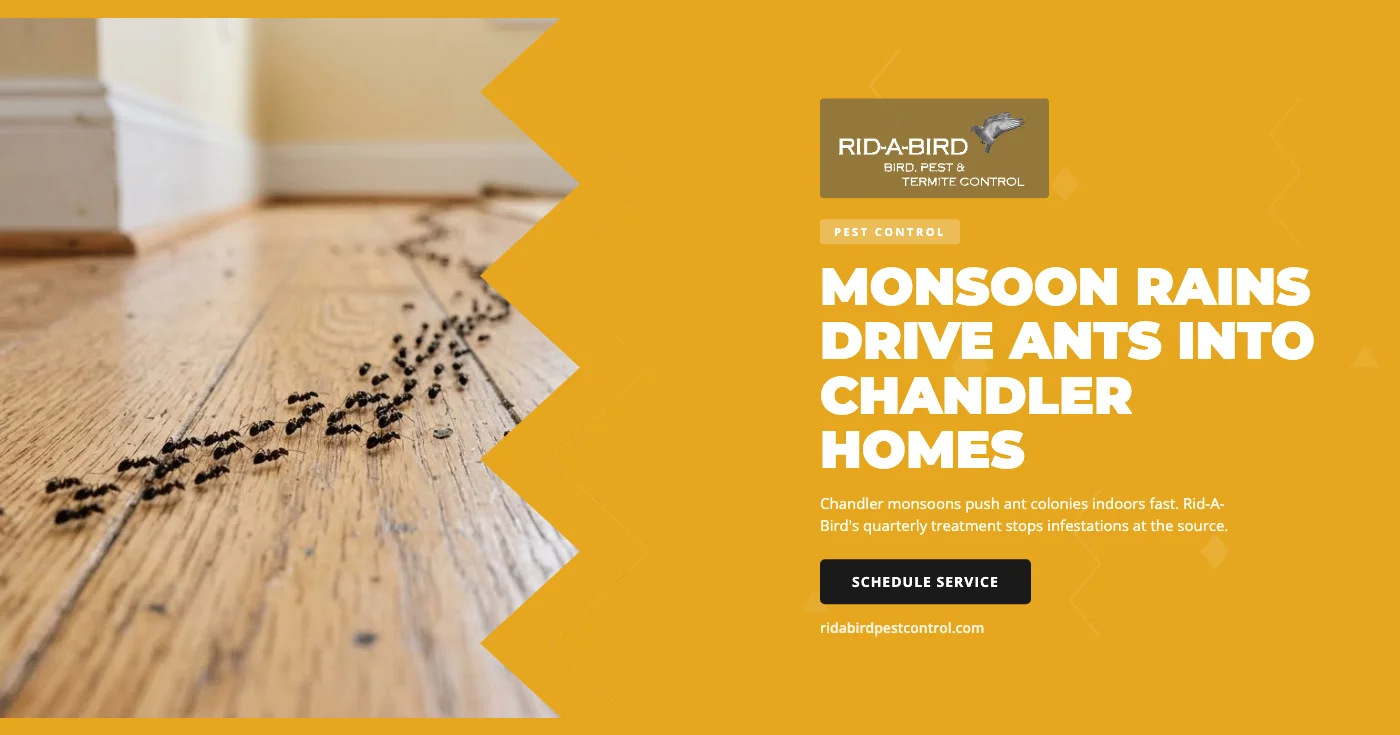
If you live in Chandler and the first big summer monsoon rolls through your neighborhood, there’s a good chance you’ll find ants on your kitchen counter within 24 hours. It happens every year. Storms move in off the desert, drop a couple of inches of rain in a single afternoon, and suddenly the colonies that have been quietly tunneling under your driveway, your patio, and your block fence get pushed straight up into your living space. Our team at Rid-A-Bird hears the same story from Chandler homeowners every monsoon: “We don’t know where they’re coming from, and there’s a new trail every morning.”
This guide walks through why ant activity spikes during Chandler’s summer monsoon season, which species you’re most likely to see indoors, how to tell the difference between a few stray scouts and a full-blown infestation, and what works (and what doesn’t) when you’re trying to handle ants in the Arizona heat. By the end, you’ll know when DIY is enough and when it’s time to bring in professional ant control Chandler AZ homeowners can trust.
Why Monsoon Season Triggers Ant Invasions in Chandler Homes
From late June through September, the Sonoran Desert flips from baking-dry to suddenly humid. Monsoon storms dump heavy rain in short bursts, and the runoff floods the underground tunnels that ant colonies have spent the entire dry season building. When water rushes into a nest, ants react fast — they pick up eggs, larvae, and pupae, and head for higher, drier ground. That higher, drier ground is almost always inside our homes.
The pattern is simple. A storm rolls in around 5 p.m., dumps an inch of rain in an hour, and by the next morning workers are scouting your kitchen for water and food. Colonies don’t need much of an opening — expansion gaps around the slab, the seal under your sliding glass door, the gap where the irrigation line runs through the stucco. Once a scout finds something worth taking back to the colony, it lays down a pheromone trail, and within hours a steady line of nestmates follows it. That’s the morning ant highway across your countertop.
Monsoon season also boosts ant activity in three other ways that make Chandler infestations worse than the rest of the year. Higher humidity means colonies can raise more brood at once, so colony size grows quickly. Cooler nighttime temperatures (relatively speaking — we’re still in the 80s) keep workers active longer than during the May-June peak heat. And the flush of new plant growth after rain triggers an aphid boom on your landscaping, which gives ants a sugar source that further fuels colony expansion.
Common Ant Species Found Inside Chandler, AZ Homes in Summer
Not all ants behave the same way, and the species that shows up tells us a lot about how to treat the problem. According to the University of Arizona Cooperative Extension, more than a dozen ant species are common across the East Valley. These are the four we deal with most often in Chandler homes during monsoon season.
Argentine ants. Small (about 1/8 inch), dark brown, and the most common indoor invader in Chandler. They form massive supercolonies that can span entire blocks, and they’re drawn to anything sweet — pet food bowls, fruit on the counter, even sugar crystals around a soda can. Argentines almost never sting, but their sheer numbers make them frustrating. If you crush a few and there are still hundreds streaming through the same gap an hour later, you’re probably dealing with Argentine ants.
Pavement ants. Slightly bigger and darker than Argentines, with two small spines on the back. They nest under driveways, patios, and sidewalk slabs, and they push fine sand grains up through the cracks. Pavement ants love grease and protein, so they’re often the ones in your trash can and pet food bowl rather than your sugar jar.
Harvester ants. These are the big red ants you see in cleared circles around the yard. They’re native desert ants and they typically stay outside, but during a heavy monsoon they sometimes get displaced into garages or pool equipment rooms. Harvesters can sting, and the sting hurts. We don’t recommend trying to handle a harvester nest yourself.
Fire ants. Reddish brown, aggressive, and a real concern for any family with kids or pets. Fire ants build dome-shaped mounds that pop up overnight after monsoon rains, and they’ll attack as a group if their nest is disturbed. Fire ant stings cause welts and can trigger allergic reactions. If you see new mounds in the yard after a storm, keep the kids off the grass until the colony is treated.
Less commonly, we also see crazy ants (fast, erratic movers that look like they’ve had too much coffee) and the occasional carpenter ant tunneling through monsoon-damaged wood. Identifying the species correctly is the first step, because the treatment that wipes out an Argentine ant supercolony won’t do much against fire ants, and vice versa.
The Difference Between a Few Ants and a Full Infestation
A handful of ants on the kitchen counter isn’t automatically an infestation. Scouts are constantly wandering, and during monsoon season a few will inevitably find their way inside. What turns a handful of ants into a real problem is when the colony decides your home is worth a full commitment.
Here are the signs that point to an actual infestation rather than a few stragglers.
- Visible trails. One ant is a scout. A line of ants moving in both directions along the same path is a colony actively foraging. Trails usually run along baseboards, countertop edges, or the silicone seam around a sink.
- Multiple rooms. Ants in the kitchen during monsoon season are normal. Ants in the kitchen, the bathroom, and the laundry room all at once means the colony has mapped out multiple food and water sources inside the home.
- Activity that returns within hours of cleanup. If you wipe down the trail with vinegar or soap, the pheromones break and traffic drops — but within a few hours, scouts reroute and a new trail appears. That cycle is the hallmark of an established colony.
- Outdoor mounds against the foundation. A fresh mound of fine soil pushed up at the base of an exterior wall, especially after rain, almost always means a nest is now in direct contact with your home’s foundation. From there, it’s a short walk through expansion gaps to your interior walls.
- Winged ants indoors. Once a year, mature colonies produce winged reproductive ants that fly out to start new nests. Seeing these “swarmers” inside the house means the parent colony has been established long enough to reproduce — a sign of a mature, well-resourced infestation.
The reason this distinction matters is that DIY treatment can sometimes clear a few scouts but rarely solves an established infestation. Spraying visible workers kills the ones you see, but it also breaks pheromone trails the colony was using to deliver bait back to the nest, which can actually make things harder to control long-term.
DIY Ant Prevention Tips That Actually Work in the Arizona Heat
Plenty of online advice for ants assumes a temperate climate. Most of it doesn’t hold up in Chandler during July. Here are the prevention steps that genuinely work in the desert during monsoon season.
Seal entry points before the storms arrive. Walk the exterior of your home in late June, before the first heavy rain. Look for gaps where the stucco meets the slab, around hose bibs, behind the dryer vent, and where irrigation lines enter the wall. Caulk anything wider than a credit card. You won’t catch every opening, but you’ll cut the easy entrances.
Eliminate water sources indoors. Ants need water as much as food. Fix dripping faucets, dry the sink at night, empty the dog’s water bowl after dark, and run the dishwasher rather than leaving dishes soaking. Removing water sources is more effective than removing food in cutting off colony interest.
Move plants and mulch away from the foundation. Decorative gravel and bark mulch hold moisture against the slab and create a humid microclimate ants love. Keep the first 12–18 inches around the foundation clear of mulch, plants, and irrigation drips. That dry barrier slows colonies from migrating to your wall.
Use bait, not spray, when you see a trail. Liquid sugar baits and gel baits work because workers carry the active ingredient back to the queen. A spray kills the workers you see but leaves the colony untouched. If you must use a contact product, target the entry gap on the exterior rather than the trail on the counter.
Clean trails with a degreasing cleaner. Disrupting the pheromone trail makes the colony work harder to re-establish, which buys you time. Plain soap and water works. Vinegar works. Bleach works but is overkill for most situations.
One thing we recommend skipping: cinnamon, essential oils, and DIY borax-and-sugar mixes. They can knock back small scout activity for a day or two, but in our experience they almost never solve a Chandler monsoon infestation. The colony is too big, the desert is too dry, and the alternative food sources are too plentiful.
When to Call a Professional Ant Exterminator in Chandler
There’s no shame in DIY, and we tell Chandler customers all the time that a few prevention steps can keep a minor ant problem from becoming a major one. But there are specific situations where calling in professional ant control Chandler AZ residents actually need is the better move.
Call us if you’re seeing any of the following.
- Ant trails that return within 48 hours of every cleanup attempt.
- Multiple entry points or trails in different rooms.
- Fire ant mounds in a yard with kids or pets.
- Winged ants (swarmers) emerging inside the house.
- Damage suggesting carpenter ants — sawdust-like frass under wood trim or wood that sounds hollow when tapped.
- An infestation that started before monsoon and never went away — that usually means the colony is well-established and DIY isn’t breaking through.
The other reason to call early in monsoon season rather than late: ant treatment schedules fill up fast across Chandler during July and August. Getting on a quarterly schedule before the second or third storm of the season is much easier than fitting in an emergency visit after the colony has been growing inside your wall for six weeks.
How Rid-A-Bird’s Ant Control Treatment Works
Our approach to ant control in Chandler is built around two principles. First, we treat the colony, not just the workers you see. Second, we use products and methods chosen for the desert climate — what works in a humid Midwest yard would evaporate or break down in our July sun.
A typical first visit looks like this. We start with a walk-around of the exterior to identify nests, entry points, and harborage areas: under pavers, against the foundation, in irrigation valve boxes, around the pool deck. Then we inspect the interior in any rooms where you’ve seen activity, mapping trails and identifying the species so we can match the product to the problem.
Treatment usually combines three tools. A non-repellent perimeter treatment around the foundation is the backbone — non-repellent products are critical because ants can’t detect them, so they walk through the treated area and carry the active ingredient back to the colony rather than avoiding it. Targeted bait placements go inside and outside where we’ve identified trails, with bait formulations matched to whether the colony is going after sugar (Argentine ants) or protein (pavement ants). And mound treatments are used for fire ants and harvester ants, where direct nest contact is the fastest way to eliminate the colony.
We follow that initial visit with a recheck and quarterly maintenance to keep the perimeter active through monsoon and into fall. Quarterly service is especially important in Chandler because new colonies move into vacated nest sites within weeks, and a single annual treatment leaves long gaps where reinvasion happens.
If you want to read more about our process and what’s included in a quarterly plan, you can find the full details on our ant control service page.
Monsoon season in Chandler doesn’t have to mean an annual ant takeover of your kitchen. With the right combination of prevention, smart DIY when it’s warranted, and professional treatment when the colony has dug in for real, you can keep the storms outside and the ants outside with them. If you’ve already spotted trails in your house this summer, the sooner we can take a look, the easier it is to get ahead of the season.