
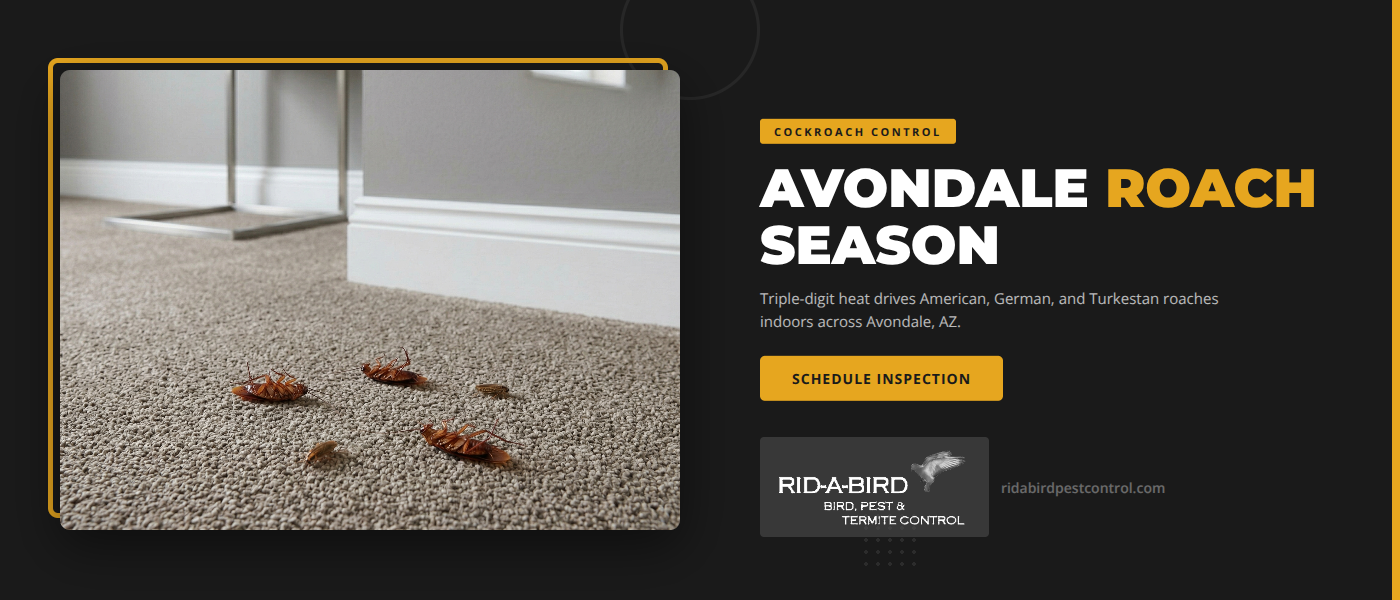
Once the Avondale, AZ thermometer cracks 105 and the irrigation timers run nightly, the cockroaches that have been quietly living in storm drains, irrigation boxes, and palm tree skirts start looking for cooler, wetter ground — and that is usually inside your home. By the time most West Valley homeowners spot the first roach skittering across a kitchen floor at night, dozens more are already nesting behind the dishwasher, in the water heater closet, or in the wall void above the laundry. If you are seeing droppings, an oily smell, or live roaches after dark, schedule professional cockroach control in Avondale, AZ before the population doubles again.
At Rid-a-bird Pest Control, we have served Avondale, Goodyear, Litchfield Park, Buckeye, and the rest of the Phoenix metro since 1991. Summer is our heaviest stretch of the year for roach work, and this guide walks through why the West Valley population explodes from late May through September, which species you are most likely to find in an Avondale home, where they hide, the health risks they bring, and the five prevention moves that actually hold up against monsoon season.
Why Avondale, AZ Summers Are Peak Cockroach Season
Cockroaches are cold-blooded, and their metabolism, breeding rate, and movement all climb as the outdoor temperature climbs. In Avondale, the average daytime high holds above 100 degrees from late May through late September, and the overnight lows hover in the mid-80s for most of July and August. That sustained heat does three things to the local roach population at once: it speeds up egg development, it dries out the outdoor harborage sites the colony was using all spring, and it pushes adults to follow plumbing, weep screeds, and slab cracks toward the cool, humid interior of your home.
According to the University of Arizona Cooperative Extension, the three roach species common to the Phoenix area each go through a full generation in roughly 60 to 100 days when temperatures stay this warm — so a small population we would barely notice in March can become a household infestation by the Fourth of July. Add the first monsoon storms in July, which flood storm drains and irrigation boxes that were sheltering outdoor populations, and you get the annual wave of indoor sightings that drives most of our Avondale calls between mid-July and Labor Day.
American, German, and Turkestan Roaches: What Avondale Homeowners Encounter
Three species do almost all of the damage in Avondale homes. Knowing which one you are dealing with changes the treatment plan, so our technicians always identify the species before we propose a program.
- American cockroach — the largest of the three, about 1.5 to 2 inches long, reddish-brown, with a yellow figure-eight pattern on the back of the head. American roaches live in sewers, storm drains, water meter boxes, and pool equipment vaults across the West Valley, and they push indoors through floor drains, plumbing penetrations, and weep holes when their outdoor sites flood or overheat. They fly short distances, which is why most Avondale homeowners first notice them on a patio light or near a garage door at dusk.
- German cockroach — the small, light-brown species, about half an inch long, with two dark stripes running down the back of the head. German roaches almost never live outdoors in Arizona. They ride into the home on grocery bags, cardboard boxes, used appliances, and food deliveries, then nest in kitchens and bathrooms because they need warmth and moisture constantly. One pregnant female can seed several hundred offspring inside a kitchen in 90 days, which is why a German infestation always escalates fast.
- Turkestan cockroach — about an inch long, with males showing tan wings and females wearing cream-colored stripes around the edges. Turkestans have replaced Oriental cockroaches across most of the Phoenix valley over the last twenty years. They live in irrigation valve boxes, block wall voids, and landscape debris, and they are the species we most often find pouring out of an Avondale water meter box during a summer service call.
If you have only seen large, fast-moving roaches near the garage or patio at night, you are most likely dealing with American or Turkestan populations driven indoors by heat. If you are seeing small, light-brown roaches inside kitchen cabinets or behind appliances during daylight, that points to a German infestation — and that one needs a professional response immediately.
Where Cockroaches Hide in Arizona Homes
Roaches need three things: darkness, warmth, and a moisture source. Avondale homes give them all three in predictable places. When we run a cockroach inspection, these are the spots we check first:
- Under and behind the refrigerator, dishwasher, and stove — warm motors plus food residue
- The water heater closet and the cabinet under the kitchen sink — constant humidity and easy plumbing access
- Around the dryer vent, washing machine drain pan, and water softener loop in the garage
- Pantry shelves, especially behind boxed grains, pet food bags, and unsealed cereal
- The void behind a recessed microwave and inside the toe-kick under cabinets
- Storage boxes in the garage, attic pull-down ladder gaps, and any cardboard kept on a concrete floor
- Exterior water meter boxes, irrigation valve boxes, pool equipment housings, and weep holes at the base of stucco
The clearest indicators of an active population are pepper-like droppings along baseboards, small dark smears around plumbing penetrations, an oily or musty odor in a closed cabinet, shed exoskeletons, and oothecae — the small, dark egg cases — wedged behind hinges and in cabinet seams.
The Health Risks of a Cockroach Infestation
Cockroaches are not just unpleasant. They are a documented public-health concern, especially in homes with children, seniors, or anyone with respiratory issues. The U.S. Environmental Protection Agency and the Centers for Disease Control and Prevention both list cockroach allergens — proteins shed from the body, saliva, and droppings — as a primary indoor asthma trigger, particularly in children. In allergic kids, exposure can drive emergency-room visits during peak season.
Cockroaches also mechanically carry bacteria from the storm drains, dumpsters, and sewer lines they travel through. Salmonella, E. coli, Staphylococcus, and several intestinal parasites have all been recovered from cockroaches walking through residential kitchens. That is the part most Avondale homeowners do not realize: a few roaches on the counter at night means contaminated prep surfaces by morning. Sealed food storage, nightly counter cleaning, and a fast professional response are not optional once a population is established.
5 Ways to Roach-Proof Your Avondale Home Before Monsoon Season
The window to harden your home is the six weeks between mid-May and early July, before the first monsoon storms flood outdoor harborage and push the population indoors. The same five moves work every year:
- Seal plumbing and slab penetrations. Every spot where a pipe, conduit, or cable passes through a wall, slab, or cabinet back is a roach highway. Foam and caulk every visible gap under sinks, behind toilets, around the water heater, and where the refrigerator water line enters the wall.
- Fix the moisture sources. A dripping irrigation valve, a leaky outdoor hose bib, condensation around an HVAC drain, or a sweating cold-water line under the sink will support a roach population by itself. Repair every drip and add a moisture mat under the dishwasher.
- Clear the perimeter. Pull mulch, stacked firewood, cardboard, and dense ground cover 18 inches back from the foundation. Trim oleanders, citrus, and palm skirts away from the roofline. Empty and tighten the lid on every irrigation valve box in the yard.
- Lock down the kitchen. Move flour, sugar, rice, cereal, and pet food into sealed glass or hard plastic containers. Wipe counters and sweep the floor every night before bed. Take trash to the outdoor bin nightly during summer — a kitchen trash can with food residue is a buffet by 2 a.m.
- Inspect everything coming through the front door. Grocery bags, Amazon boxes, used appliances, and secondhand furniture are the most common way a German cockroach population enters an Avondale home. Break down boxes outdoors before bringing contents inside.
When DIY Sprays Fail and You Need a Professional
Over-the-counter foggers, "bug bombs," and contact sprays kill the roaches you can see and leave the egg cases, hidden adults, and the entire wall-void population untouched. Worse, foggers scatter populations across multiple rooms, turning a kitchen problem into a whole-house problem within days. The University of Arizona Cooperative Extension and the EPA both recommend integrated pest management — exclusion, sanitation, targeted baits, growth regulators, and crack-and-crevice treatments — instead of broadcast sprays.
Call us if you see any of the following: a German cockroach during the day, more than two large roaches indoors in a single week, droppings or egg cases inside a cabinet, the oily musty odor of an established colony, or any roach activity in a home with a child who has asthma. By the time you are seeing daytime activity, the visible population is roughly 10 percent of the total — the rest are nesting in voids you cannot reach with a can of spray.
How Rid-A-Bird Treats Cockroach Problems in Avondale, AZ
Our Avondale cockroach service starts with a full interior and exterior inspection — we identify the species, map the harborage points, and document the moisture and exclusion gaps that are feeding the population. From there, the treatment plan is built around the species we found.
For American and Turkestan populations, we run perimeter exclusion at every weep screed, plumbing penetration, irrigation box, and slab crack, then apply long-residual products to the harborage zones — water meter boxes, valve boxes, garage thresholds, dryer vents, and roof drains. For German cockroach infestations, we work room by room with targeted gel baits, an insect growth regulator, and crack-and-crevice work behind every appliance, plus a follow-up two to three weeks later to break the egg cycle. Recurring quarterly service keeps the perimeter pressure on through monsoon season so the next wave never reaches your living space.
We have been treating cockroach problems across Avondale, Goodyear, Litchfield Park, and the rest of the West Valley since 1991, and every program comes with a no-nonsense follow-up window if activity returns between scheduled visits.
Frequently Asked Questions About Cockroach Control in Avondale, AZ
How long does it take to get rid of cockroaches in an Avondale home? An American or Turkestan perimeter problem usually shows a sharp drop within 7 to 14 days of the first treatment. A German cockroach infestation in a kitchen typically needs two to three visits across four to six weeks to fully break the egg cycle.
Will one treatment work, or do I need ongoing service? A single treatment knocks down the visible population, but Avondale's outdoor pressure — irrigation boxes, storm drains, neighboring yards — refills the perimeter every monsoon season. Quarterly service is what keeps the indoor population at zero year over year.
Are the products you use okay around pets and kids? Our technicians use targeted, low-impact products applied to cracks, voids, and exterior harborage — not broadcast sprays on living surfaces. We walk every household through a re-entry window before we start, and we adjust the plan in homes with pets, kids, or allergy sensitivities.
What is the difference between a roach problem and a roach infestation? One or two roaches a month in the garage during summer is a perimeter pressure problem and is normal in Avondale. Multiple sightings indoors in a single week, daytime activity, droppings, or egg cases inside cabinets is an active infestation that needs a professional response.
Do you service Goodyear, Litchfield Park, and Buckeye as well? Yes. Our Avondale cockroach service covers the entire West Valley, and our team has been treating Phoenix-area roach problems since 1991. To schedule an inspection, visit our pest control services page.