
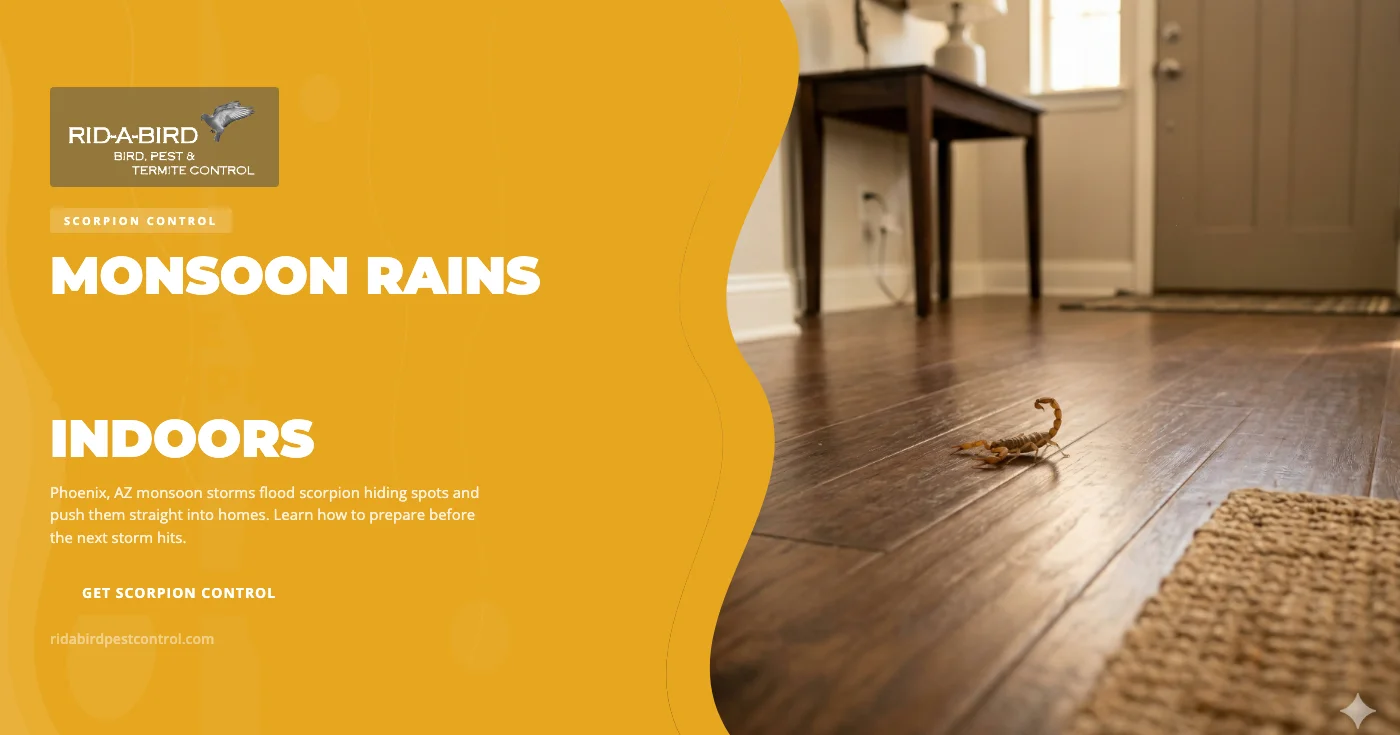
When monsoon storms roll across Phoenix in July and August, our call volume climbs the next morning. Heavy rain disturbs the desert in ways homeowners rarely think about — flooding washes, soaking block walls, driving moisture into shelters that have been bone-dry for months. Scorpions respond by leaving their harborage and looking for higher, drier ground. For many Phoenix homes that higher ground is the garage, the laundry room, or the cool side of a foundation wall. That is why monsoon season produces more indoor sightings than any other time of year, and why effective scorpion control in Phoenix has to account for storm activity rather than summer heat alone.
At Rid-a-bird, our team has worked the Valley since 1991. The pattern we see every year is consistent: rain triggers a wave, the wave reaches homes within 24 to 72 hours, and the families who prepared before the first storm see far fewer scorpions inside. This guide covers why monsoon season hits Phoenix so hard, where scorpions actually go during storms, and what works to keep them out.
Why Phoenix Scorpions Surge During Monsoon Season
Scorpions are night-active ambush predators, and their behavior is tightly coupled to two variables: temperature and prey availability. Monsoon storms spike both. Cricket, cockroach, and termite swarmer populations explode within days of a soaking rain, giving scorpions an enormous food pulse right when overnight temperatures hold in the 80s and 90s. According to the University of Arizona Cooperative Extension's guide to scorpions of the desert Southwest, populations are densest in low-desert communities around irrigated landscaping that supports their prey — a description that fits almost every Phoenix neighborhood.
Bark scorpions need very little water, but humid air after a storm reduces their dehydration risk and encourages longer foraging trips. The combination of warm nights, abundant prey, and humid air is why July and August are the busiest months on our calendar for scorpion treatment in Phoenix.
How Sudden Rains Push Scorpions Out of Their Hiding Spots
The behavior most homeowners do not anticipate is the flooding response. Scorpions spend daylight hours tucked into block-wall voids, packrat middens, irrigation valve boxes, and burrows under decorative landscape rock. Many of these shelters sit just below grade. When a monsoon cell drops an inch of rain in twenty minutes, those shelters fill with water — and the scorpions inside have to evacuate.
The University of Arizona Pest Management Center confirms this in its public-health IPM guidance, noting that scorpions relocate when flooded out of refuge areas after monsoon rains. The ones that evacuate climb. They follow gradient changes upward toward drier surfaces — block walls, foundation stems, garage thresholds, slab edges. From there, any opening larger than a credit card is a viable entry point.
This is why the 24-to-72-hour window after a Phoenix storm matters so much. The scorpions you see in the laundry room on Wednesday morning came from a soaked block wall on Monday night. Pre-storm exclusion is the single most effective intervention we offer for monsoon scorpions in Arizona, because the timeline between rain and indoor sighting is too short to react after the fact.
Common Scorpion Species Phoenix Homeowners Encounter
Phoenix homeowners regularly encounter three scorpion species. Knowing which one is on your property changes how serious the situation is and how our team approaches treatment.
Arizona bark scorpion (Centruroides sculpturatus). The species that drives most of our service calls. Adults run 2 to 3 inches long with a slender body, thin pincers, and a long, narrow tail, typically pale yellow to light tan. As the Arizona bark scorpion entry from Wikipedia notes, this is the only scorpion of medical concern in the United States, and stings can cause severe pain, numbness, and other symptoms that typically resolve over 24 to 72 hours. Bark scorpions are the only local species that climb — they scale stucco, block walls, and tree bark, and they can reach ceilings, picture frames, and upper-floor rooms.
Desert hairy scorpion (Hadrurus arizonensis). The largest scorpion in North America at 4 to 6 inches, with thick pincers, a heavy tail, and pale yellow legs. Despite their size, their venom is far less potent than the bark scorpion's. We see them most often in rocky desert margins — North Phoenix, foothill lots, and properties backing onto preserves like the Sonoran Preserve and South Mountain Park.
Stripe-tailed scorpion (Paravaejovis spinigerus). A medium-sized tan scorpion with darker stripes along the segments of its tail. Common across Phoenix and often mistaken for the bark scorpion, but stripe-tailed scorpions cannot climb vertical surfaces and their stings, while painful, are not medically dangerous.
The practical takeaway: any scorpion indoors warrants attention, but bark scorpion activity warrants a professional response, especially in homes with children, older adults, or anyone with allergic sensitivities.
Where Scorpions Sneak Into Phoenix Homes After Storms
Entry points we identify during post-storm inspections are remarkably consistent across Phoenix neighborhoods. Block-wall construction, slab-on-grade foundations, and the thermal-cycling gap between stucco and concrete all create the openings scorpions need. The routes we find most often include:
- Garage doors with worn weather stripping — the gap at the bottom of an aging garage door is wide enough for a bark scorpion to walk under without contact
- Plumbing and gas line penetrations — pipes coming through stucco or block leave small gaps that go unnoticed for years
- Exterior door thresholds — front doors, side gates, and patio sliders with compressed weather stripping
- Dryer vents and bathroom exhaust vents — especially when the louver is broken or stuck open
- Roof tile underlayment and attic access — bark scorpions climb stucco walls and enter attics, then drop down through can lights and HVAC penetrations
- Foundation expansion cracks — narrow vertical cracks in the slab edge that open during heavy heat
- Pool equipment chases and irrigation valve boxes against the house — sheltered, often slightly damp, and rarely inspected
The structure itself is rarely the problem. The conditions around it — landscaping pulled tight against the wall, untreated block, exterior lighting drawing prey — are what create the pressure.
Warning Signs of a Scorpion Problem on Your Property
Most homeowners do not realize they have an active population until they see one inside. By that point the property has usually supported scorpions for months. Earlier signs are easier to miss but more useful for prevention:
- Repeat sightings in the same area — two scorpions in the same patio corner or the same garage threshold within a few weeks means active harborage nearby
- Bark scorpions on vertical surfaces at night — stucco walls, fence posts, or tree trunks indicate climbing activity that often leads to roof and attic entry
- Cricket and cockroach pressure climbing in spring — prey populations precede predator populations
- Scorpions found in shoes, towels, or laundry baskets — they are already inside and using dark, undisturbed harborage
- Pets fixating on baseboards or floor drains — dogs and cats often detect scorpion activity well before humans
- Shed exoskeletons in garage corners, planters, or block-wall caps — proof of an established, breeding population
If you notice any of these patterns, scheduling an inspection before monsoon season hits is significantly more effective than calling after the first indoor sighting in July.
Why DIY Scorpion Control Often Fails in the Desert
Hardware stores around Phoenix stock scorpion sprays, granules, and ultrasonic devices every summer. We talk to homeowners every week who tried the full lineup and still found a bark scorpion in the hallway. A few reasons this happens consistently: scorpions have a waxy cuticle that resists contact insecticides far better than most pests, the harborage driving indoor activity sits inside block-wall voids that homeowners cannot reach, and ultrasonic repellent devices have no documented behavioral effect on scorpions in university studies.
The University of Arizona Extension is direct about this: scorpions cannot be managed using pesticides alone. Successful long-term control requires habitat modification and prey-insect management combined with targeted professional treatment. That is the model we run on every Phoenix property we service.
How Rid-a-bird Treats and Prevents Scorpion Infestations
Our scorpion service for Phoenix homeowners begins with a property inspection — usually combined with a nighttime UV walk-through when activity warrants — to identify harborage sites and entry points. Scorpions fluoresce a bright blue-green under ultraviolet light, which lets our team locate active harborage in block walls, landscape rock, and tree bark that would be invisible under a regular flashlight.
From there our technicians apply targeted treatment to perimeter walls, block-wall voids, and identified entry points, and we recommend exclusion work where gaps allow indoor access. Recurring service paired with our general pest control program keeps prey insect populations down so the property does not rebuild scorpion pressure month over month.
Our team serves Phoenix along with Scottsdale, Paradise Valley, Glendale, Peoria, Anthem, Sun City, Goodyear, and the rest of the Valley. To schedule a property inspection before the next storm system rolls through, visit our scorpion pest control page.
Monsoon-Season Scorpion Prevention Checklist for Phoenix Families
If you want to interrupt the monsoon-season pattern on your property, the work below is what we recommend to Phoenix homeowners every June, before the first storm cell arrives.
- Install or replace door sweeps on every exterior door, including garage interior doors and any side-yard gate door into the house
- Caulk plumbing, gas line, and electrical penetrations through stucco and block at the foundation level
- Screen dryer, bathroom, and attic vents with quarter-inch metal mesh
- Pull decorative rock, wood piles, and stacked landscape material at least 20 feet from the foundation
- Trim oleander, bougainvillea, and ground cover so it does not touch exterior walls or roofline
- Switch exterior bulbs to amber or yellow to reduce the prey insects scorpions follow toward the house
- Direct downspouts and irrigation runoff away from the foundation to limit moisture pooling along the perimeter
- Shake out shoes, towels, and bedding before use during July, August, and September
- Schedule a pre-monsoon UV inspection with a licensed pest control company that can identify harborage and treat block-wall voids
Most of these steps cost very little to implement individually. Together, they shift a Phoenix property from being a high-pressure scorpion environment to a low-pressure one before the rains start.
Frequently Asked Questions About Scorpion Control in Phoenix, AZ
When is monsoon scorpion season in Phoenix?
The Phoenix monsoon officially runs from June 15 through September 30, but the storm cells that drive scorpion activity most heavily typically arrive in mid-July and peak through August. Indoor sightings climb sharply in the 24 to 72 hours after a soaking rain and stay elevated through September as humid conditions persist. The most effective time to prepare is May and June, before the first storm pushes scorpions out of flooded harborage.
Why do I see more scorpions after it rains in Phoenix?
Heavy monsoon rain floods the block-wall voids, burrows, and landscape harborage where scorpions spend their days. They evacuate upward to higher, drier ground — which often means the foundation, garage threshold, or interior of your home. The post-storm spike is the most predictable behavioral pattern we see during monsoon season in Phoenix.
Are bark scorpions in Phoenix really dangerous?
The Arizona bark scorpion is the only scorpion of medical concern in the United States. Stings cause severe pain, numbness, and tingling, and in young children, older adults, or people with allergic sensitivities, the reaction can require medical attention. The other Phoenix-area species are painful to be stung by but are not medically dangerous. Any bark scorpion sighting indoors warrants a professional response, especially in homes with vulnerable family members.
Does Rid-a-bird treat for scorpions in Phoenix, AZ?
Yes. Rid-a-bird provides scorpion pest control in Phoenix along with the rest of the Valley. Our technicians have worked these neighborhoods since 1991, and we combine UV detection, targeted perimeter treatment, exclusion recommendations, and recurring prey-insect control through our general pest control program to keep activity down through monsoon season and the rest of the summer.