July in Surprise, AZ brings a dramatic shift. After months of hot, dry conditions, the monsoon rains arrive — and with them comes a surge in termite swarming activity that catches many homeowners off guard. If you've seen winged insects emerging from your yard or exterior walls after a rainstorm, or noticed mud tubes appearing on your foundation in recent days, you're seeing termite behavior that's perfectly predictable for this time of year in the West Valley.
At Rid-a-bird, we provide professional termite control in Surprise, AZ and throughout Maricopa County. We've developed a treatment approach that goes beyond traditional in-ground bait stations to address the specific ways Arizona termites behave — and we'll explain exactly what you should be watching for this monsoon season and what to do when you find it.
Why Arizona's Monsoon Season Kicks Off Termite Swarming
Arizona's two most destructive termite species — subterranean termites and drywood termites — both respond to monsoon moisture in ways that increase their visibility and their threat to homes.
Subterranean termites build underground colonies that can contain hundreds of thousands of workers. For most of the year, these colonies are expanding quietly beneath the soil, foraging outward in search of cellulose. When monsoon rains arrive, soil moisture spikes and temperatures moderate slightly from daytime highs — triggering the production of winged reproductives called alates. These swarmers emerge in large numbers from the ground and from existing mud tubes, taking flight to find mates and establish new colonies. A termite swarm can involve thousands of alates emerging in a matter of minutes.
For Surprise homeowners, seeing a swarm doesn't necessarily mean termites are inside your home — swarms often originate from colonies in the surrounding landscape. However, it does mean active colonies are nearby and foraging activity toward your home's foundation is likely. Monsoon moisture also softens previously dry soil, making it easier for subterranean termite colonies to expand their foraging tunnels in new directions, including toward your foundation.
Drywood termites behave differently — they live entirely inside the wood they're consuming rather than maintaining underground colonies. Monsoon humidity softens wood fibers and creates conditions drywood termites can exploit to expand their galleries or establish new entry points through exposed wood on rooflines, fascia boards, window frames, and exterior trim.
Signs of Termite Activity to Watch for in Surprise, AZ This July
Monsoon season is the time to pay close attention to specific warning signs around your Surprise home. Termites are rarely loud or obvious, but they leave behind evidence that's identifiable when you know what you're looking for.
Swarmers and discarded wings — Winged termites emerging from your yard, foundation, or eaves are the most visible sign of nearby termite activity. After mating, swarmers shed their wings, leaving small piles of translucent wings on windowsills, door thresholds, and near exterior lights. Swarmers are often confused with flying ants — look for equal-length wings (termites) versus unequal-length wings (ants) and a straight body without the pinched waist ants have.
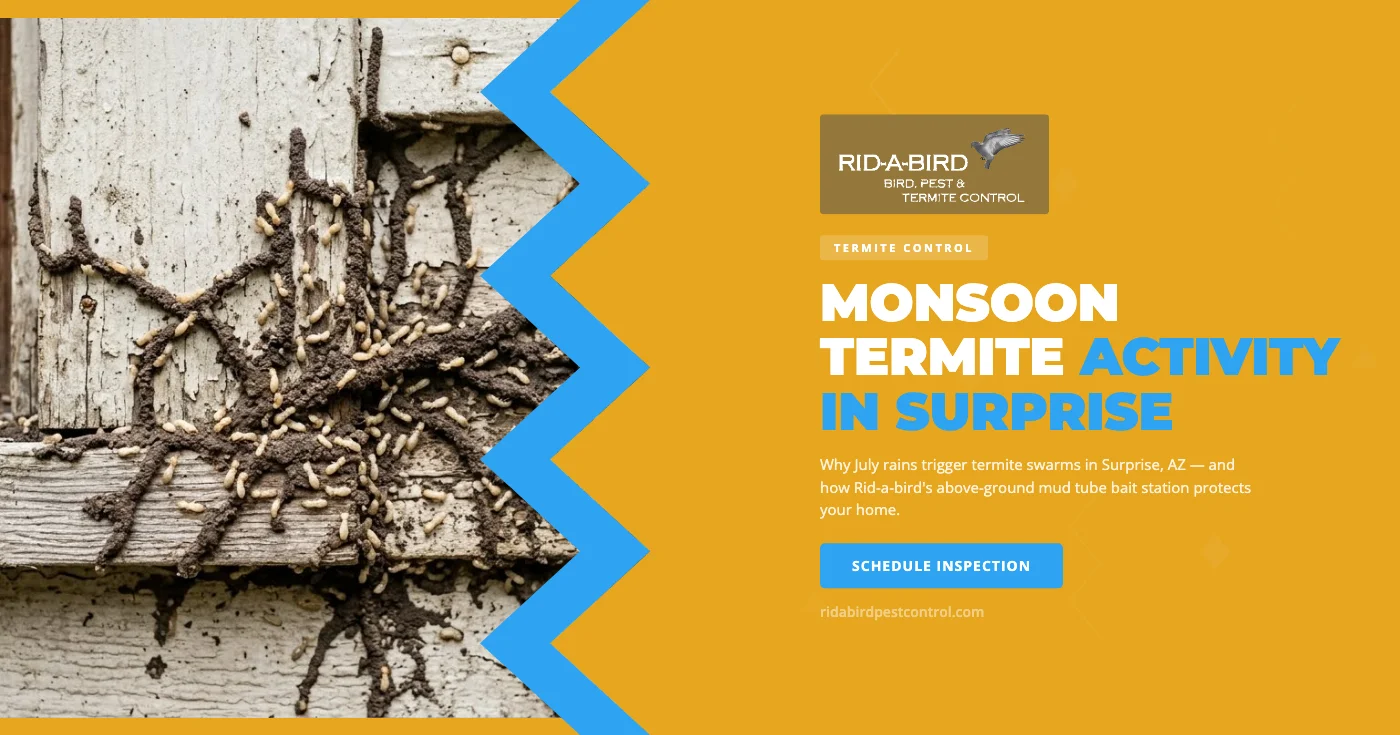
Mud tubes on exterior walls — Subterranean termites build mud tubes — pencil-width tunnels made from soil and termite saliva — to travel from the soil to above-ground wood sources while maintaining the humidity they need to survive. Mud tubes on your foundation walls, exterior block, stucco, or attached garage walls are a definitive sign of subterranean termite activity. In Surprise's rocky, caliche-heavy soil, mud tubes sometimes appear in unusual locations as termites navigate around hard soil layers.
Hollow-sounding or damaged wood — Tap on wood surfaces around your home's perimeter, baseboards, door frames, and window sills. Wood that sounds hollow or papery may have been hollowed out by termite feeding while the outer surface remained intact. This is particularly common with subterranean termites that consume wood from the inside out.
Frass (drywood termite feces) — Drywood termites push their fecal pellets out of kick-out holes in infested wood. Frass looks like small, hard pellets — similar in size to coffee grounds — and is found in small piles on horizontal surfaces below infested areas. Finding frass is a specific indicator of drywood termite activity.
Tight-fitting doors and windows — Termite activity inside wood framing can cause subtle structural movement that makes previously well-fitting doors and windows difficult to open or close. This is often one of the first symptoms homeowners notice in ongoing infestations.
Subterranean vs. Drywood Termites: Which Is Threatening Your Home?
Both termite types are present in the Surprise, AZ area, and they require different treatment approaches. Understanding which species you're dealing with informs the right response.
Subterranean termites are the more structurally destructive of the two in Arizona. Their underground colonies can be enormous — mature Formosan subterranean termite colonies, present in parts of Maricopa County, can contain millions of workers and cause severe structural damage in as little as a year. Desert subterranean termites and arid-land subterranean termites are the native species most common in the West Valley. Subterranean termites must maintain contact with soil or another moisture source to survive, which is why mud tubes are central to their foraging behavior.
Drywood termites live entirely within the wood they infest and require no soil contact. They're slower to cause structural damage than subterranean colonies, but they're also harder to detect since they leave no mud tubes and may not produce visible swarmers for years. Drywood termite infestations in Surprise are most commonly found in attics, roof framing, window frames, and exterior wood trim. Treatment often requires targeted fumigation or direct wood treatment rather than soil-applied products.
How Rid-a-bird's Above-Ground Mud Tube Bait Station Works
For subterranean termites in Surprise, AZ, Rid-a-bird uses an above-ground mud tube bait station approach that targets termites where they're actively foraging — rather than waiting for them to find in-ground stations buried in the soil.
When termites are actively building mud tubes on your foundation, those tubes represent a live highway of termite workers traveling between the colony and the wood source they're consuming. An above-ground bait station placed directly over an active mud tube intercepts termites at their existing foraging path. Termites readily accept the cellulose-based bait matrix and take it back to the colony, where it's shared with other workers and reproductives.
The active ingredient in professional termite bait works by disrupting the molting process. Termites can't develop resistance to this mechanism of action in the way they can to some liquid termiticides. As bait moves through the colony, worker populations decline, queen reproduction is affected, and the colony is systematically reduced rather than simply repelled.
Above-ground placement is particularly effective when termites are actively swarming or when fresh mud tubes have recently appeared — exactly the conditions Surprise homeowners are likely to find in July. The response time is faster than waiting for termites to discover in-ground stations placed in unforaged areas of the yard.
Why In-Ground Bait Stations Aren't the Only Option — and What We Use Instead
Traditional subterranean termite treatment in Arizona has relied heavily on liquid termiticide applied in trenches around a home's foundation, or on in-ground bait stations installed at regular intervals in the perimeter soil. Both approaches have value in certain situations, but they aren't always the most effective or most efficient solution.
In-ground bait stations work by waiting for termites to encounter the station during their normal foraging. In Surprise's rocky, caliche-dense soil, foraging patterns can be unpredictable — termites may not encounter in-ground stations for months, or may avoid certain areas of the yard altogether based on soil conditions. When stations are discovered, they do work effectively, but the discovery timeline varies significantly.
Liquid termiticide treatments create a chemical barrier in the soil around the foundation. When termites contact the treated zone, they're either repelled or killed. Non-repellent termiticides work better than repellent ones because they allow termites to pass through the treated zone and take the active ingredient back to the colony. However, liquid treatments are most effective when applied uniformly — something that can be challenging in Surprise properties with extensive concrete hardscaping, root systems, or foundation irregularities.
At Rid-a-bird, we select and combine treatments based on the specific evidence we find at your Surprise property. When active mud tubes are present during monsoon season, above-ground bait stations give us a faster direct intervention point. For properties with high infestation pressure or evidence of interior activity, we may recommend a combination of approaches tailored to your home's structure and the species involved.
Act Now: Protecting Your Surprise Home Before Monsoon Termite Damage Sets In
The weeks following the first monsoon rains of the season are when termite colonies are most actively expanding and when new swarms are establishing new infestations. Acting now — rather than waiting for visible damage — is the most cost-effective approach to protecting your Surprise home.
Structural termite damage in Arizona is significant. The University of Arizona Extension estimates that termites cause more than $1.5 billion in structural damage annually in the state. Maricopa County, including Surprise and the West Valley, is among the highest-risk areas for termite pressure in the country due to the combination of desert-adapted termite species, warm year-round temperatures, and the construction methods common in the region.
If you're seeing any of the warning signs described above — swarmers, mud tubes, frass, hollow-sounding wood, or structural changes to doors and windows — schedule an inspection as soon as possible. The longer an infestation continues unaddressed, the more extensive the treatment required and the greater the repair costs involved.
Rid-a-bird serves Surprise and the surrounding West Valley communities with professional termite inspections and treatment programs designed for Arizona's specific termite pressure. Contact us to schedule an inspection and learn more about our above-ground mud tube bait station approach and the other termite control services we provide in Surprise, AZ and Maricopa County.