
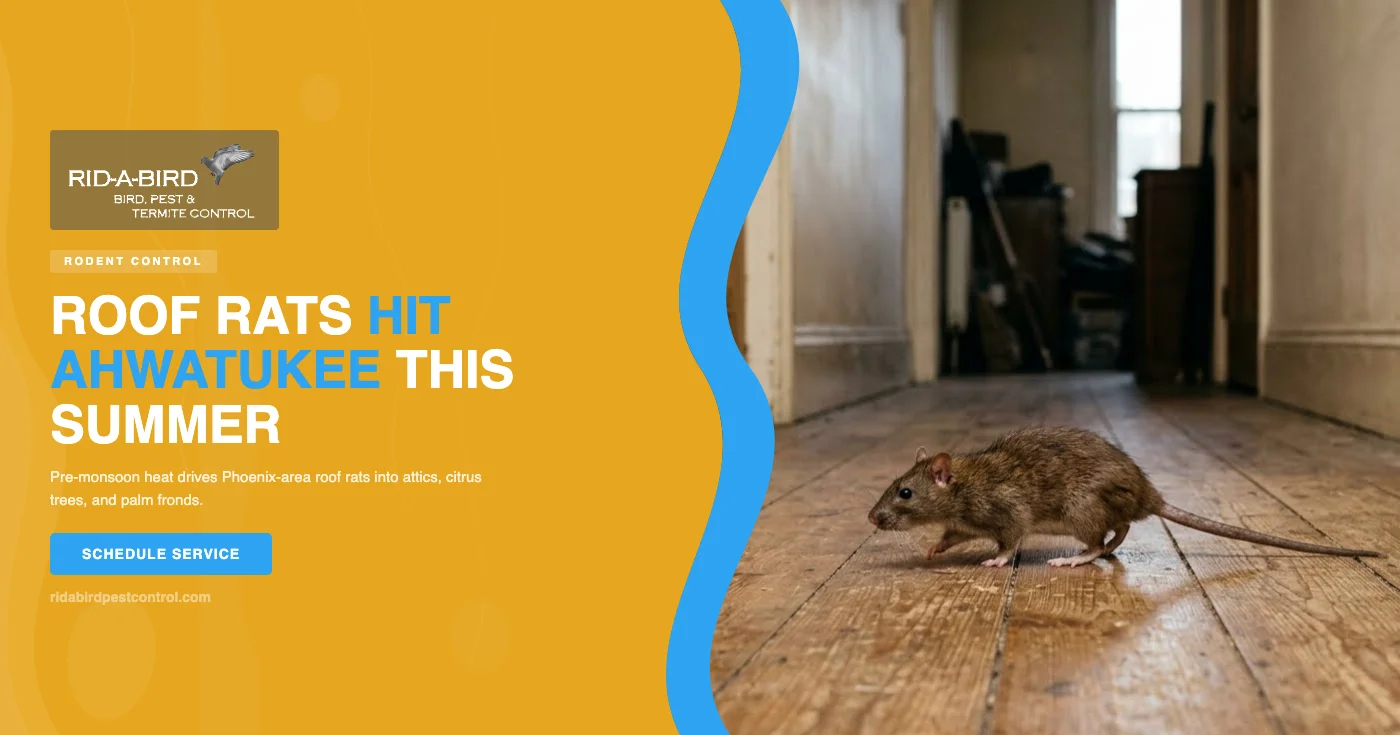
Phoenix-area summers don't just wear out people — they wear out wildlife habitat. By the time mid-June pushes daytime highs over 110°F in Ahwatukee, AZ, every wild rodent in the South Mountain foothills is hunting for cooler ground, water, and food that didn't shrivel in the heat. That hunt almost always points up: into the citrus canopy in Ahwatukee Foothills backyards, across the block walls between Lakewood and Mountain Park Ranch, and through soffit gaps into the attic above your bedroom. At Rid-a-bird we work roof rats ahwatukee az calls every summer, and the pattern repeats: heat, citrus, palm fronds, and one missed roofline gap turn into a full attic infestation in under six weeks. This guide lays out what's happening, how to spot it early, and what to do before monsoon pushes the problem inside.
Why Roof Rats Thrive in Ahwatukee, AZ Summer Heat
Ahwatukee sits up against the South Mountain Park preserve — one of the largest municipal parks in the country — and that proximity is the single biggest reason roof rat pressure spikes from June through September. Native rodent populations in the desert washes and rock piles of South Mountain hit a thermal ceiling in early summer. Ground temperatures in open sun climb past 150°F and native cover dries out fast. Developed Ahwatukee neighborhoods offer the opposite: dense irrigated landscaping, shaded block walls, year-round citrus, and attics that hold a steady 90–110°F even when the outside air is 115°F.
That gradient pulls roof rats out of the desert and into the residential Ahwatukee corridor. Once they find a citrus tree or fan palm with cover, they move yard to yard along the block walls and nest in the closest undisturbed cavity — almost always an attic, soffit return, or solar conduit. Our calls in the 85044, 85045, and 85048 ZIPs climb sharply every June and don't taper until October.
Roof Rats vs. Pack Rats: How to Tell Them Apart
Both species show up across the Phoenix metro, and a wrong ID leads to the wrong treatment plan. Roof rats (Rattus rattus) and pack rats (Neotoma albigula, the white-throated woodrat) look superficially similar but behave very differently. The giveaway is almost always the tail.
- Roof rats are slender, 6–8 inches long, dark gray to black, with a long, thin, scaly tail noticeably longer than their body. They are excellent climbers and will be in your attic, on your roof, or in your citrus tree before they're ever on the ground.
- Pack rats (Sonoran woodrats) are stockier, lighter brown to gray, with white bellies and feet, large round ears, and a noticeably furry, somewhat bushy tail that is shorter than the body. They build characteristic stick-and-cactus middens — those messy debris piles tucked under sheds, around AC units, or in engine compartments.
The University of Arizona Cooperative Extension has a useful field-level rat identification guide we point homeowners to when there's a single sighting and no nest yet. The treatment for a packrat midden behind a shed is not the treatment for a roof rat colony in a Lakewood attic, and we want the right answer before we set the first trap.
Top Signs of a Roof Rat Infestation in Your Ahwatukee Home
By the time most Ahwatukee homeowners call us, the colony is already six to ten rats deep. The earlier signals are quieter, but if you know what to watch for you can catch the infestation in its first two or three weeks:
- Scratching, scurrying, or rolling sounds in the attic at night, usually starting an hour or two after sunset and again before dawn. Roof rats are strictly nocturnal.
- Capsule-shaped droppings, 12–13 mm long with pointed ends, concentrated along attic joists, behind garage boxes, and along the top of the block wall behind your citrus tree.
- Hollowed-out oranges, grapefruits, or lemons still hanging in the tree — rind cleanly chewed away while the fruit is still attached.
- Greasy smudge marks along the top edges of block walls, eaves, soffit vents, and roof transitions where rats run the same path night after night.
- Gnaw marks on irrigation lines, low-voltage wiring, palm-frond bases, or attic lumber. Roof rats chew constantly to manage their incisor growth.
- Citrus leaves stripped to the petiole or palm fronds chewed at the base where the rats are pulling food and nesting fiber.
One or two of those signs is enough to put an attic inspection on the schedule. Three or more means there's already an active colony and we want to be on site that week.
Why Citrus Trees and Palm Fronds Invite Rats Indoors
The Ahwatukee Foothills are one of the most heavily landscaped sections of the Valley, and the same trees that make the neighborhood gorgeous in March make it irresistible to roof rats in July. Mature navel oranges, Mexican limes, Eureka lemons, and grapefruit trees in a typical Lakewood backyard produce more fruit than most families pick, and the unpicked fruit becomes a year-round buffet. A single mature grapefruit tree with windfall fruit on the ground can support a colony of 8–12 rats indefinitely.
Fan palms compound the problem. The dead frond skirt at the top of an unmaintained palm is a textbook roof rat nest site — shaded, ventilated, fibrous, and elevated above ground predators. Once a colony is established in a backyard palm, the rats reach the roofline by climbing the rough trunk and crossing the eaves to find an attic opening.
That combination is what makes Ahwatukee, AZ such a high-pressure neighborhood for roof rats every summer: cool, irrigated yards full of food, surrounded by hot, dry, food-stressed desert. Trimming citrus to keep low branches off the ground, picking up windfall fruit, and skinning palms to remove dead frond skirts strips the harborage and food source that keeps colonies alive between attic invasions.
Health Risks Roof Rats Pose to Phoenix-Area Families
Beyond the noise and structural damage, roof rats carry real disease risk for Phoenix-area families. The U.S. Centers for Disease Control and Prevention notes that rats and mice can spread more than 35 diseases to humans, directly through bites or contaminated food, or indirectly through fleas, ticks, and mites that have fed on the rat. Leptospirosis, rat-bite fever, salmonellosis, and murine typhus all show up in Arizona public health data.
The secondary risks for an Ahwatukee household are just as real:
- Rat urine and dried droppings in attic insulation become airborne particulates that cycle into living-space air through the HVAC.
- Gnawed low-voltage and HVAC wiring is a fire risk — one we have documented on multiple attic inspections in the foothills.
- Contaminated citrus picked from the tree can transmit pathogens to anyone who eats it without realizing a rat fed on it first.
- Pets — especially dogs that catch rats in the yard — can pick up parasites and bacterial infections that pass through to the family.
For households with young kids, older parents in the home, or anyone with respiratory conditions, those risks are reason enough to treat any confirmed roof rat sighting as a same-week service request.
Pre-Monsoon Rodent-Proofing Steps for Ahwatukee Homeowners
The right window for rodent-proofing in Ahwatukee is May and early June — before the first monsoon storm rolls in off the Gulf of California and drives every roof rat in the South Mountain corridor looking for shelter. Our pre-monsoon punch list for an Ahwatukee home covers seven items:
- Soffit and roofline inspection. Every soffit return, gable vent, and tile-to-fascia transition gets pressed and checked. Roof rats only need a hole the size of a quarter.
- Attic vent screening. Standard plastic and fine aluminum vent screens are not rat-rated. We back-screen with 19-gauge galvanized hardware cloth.
- Utility penetration sealing. Refrigerant line sets, condensate drains, plumbing vents, and electrical conduit all get sealed with hardware cloth, copper mesh, and rodent-rated sealant.
- Garage door bottom seal. A worn garage door sweep is a 24/7 invitation. We confirm and replace as needed.
- Citrus pruning and palm skinning. Low branches lifted 36 inches off the ground, windfall fruit picked up weekly, dead frond skirts removed from any palm over eight feet.
- Block wall and trellis inspection. We look for gaps where block walls meet stucco — common in older Ahwatukee neighborhoods — and at any trellis or solar conduit run that lets rats reach the roofline.
- Interior trap and monitor placement. Even on a clean attic, we set monitor stations in high-traffic corners so a future incursion shows up on a service visit, not after weeks of damage.
For homes that have already had one infestation, we layer a quarterly exterior general pest control service on top of the exclusion work. Knocking ant, cockroach, and scorpion populations down in the yard removes one of the indirect food draws that supports roof rat colonies between fruiting seasons.
How Rid-a-bird Solves Ahwatukee Roof Rat Problems
When an Ahwatukee customer calls us about scratching in the attic, our process is the same every time: a same-week exterior walk to map entry points, an attic inspection to confirm nest activity, and a written scope covering population reduction, full exclusion, and follow-up verification that the attic stays clear.
Population reduction pairs snap-traps with tamper-resistant bait stations, chosen for the structure and tailored around pets, kids, and the homeowner's preferences. Exclusion uses hardware cloth, copper mesh, and rodent-rated sealant. Verification runs follow-up attic walks and monitor stations to confirm zero new activity over 30 and 60 days. Every Ahwatukee roof rat job is paired with our standard rodent control follow-up to keep pressure off the home through monsoon and into the fall.
We have been working pest control in the Phoenix metro since 1991 and Ahwatukee since the original Lakewood and Mountain Park Ranch buildouts. That local knowledge — which neighborhoods see the worst pressure, which block-wall styles get exploited first, which palms are the worst harborage — is what makes our exclusion work hold up season after season.
Frequently Asked Questions
How do I know if I have roof rats in my Ahwatukee attic?
Nighttime scratching from the ceiling, capsule-shaped droppings along attic joists or above kitchen cabinets, hollowed-out citrus still on the tree, and dark smudge marks on the block wall or soffit edges are the clearest signs. One sign warrants an inspection; two or more usually means an active colony.
Why are roof rats worse in Arizona summer?
Heat drives rats out of open desert and into shaded, irrigated neighborhoods where food, water, and cool nesting cavities are concentrated. Ahwatukee's combination of mature citrus, palm trees, and attic access against the South Mountain preserve makes pressure highest from June through September.
Will trimming my citrus tree get rid of roof rats?
Pruning removes harborage and food access, which slows colony growth and pushes rats to look for other yards — but trimming alone will not evict an established attic colony. Pruning combined with exclusion and population reduction is what clears the problem.
Are roof rats the same as pack rats?
No. Roof rats are dark, slender, and have long bare tails; they live in trees and attics. Pack rats (Sonoran woodrats) are stockier, lighter brown, with furry tails, and build stick-and-cactus middens at ground level. The two species need different treatment plans.
Is rodent bait a concern around pets and kids?
We use tamper-resistant exterior bait stations with secured bait blocks, placed where pets and children cannot reach them. Indoors and in the attic we generally lean on snap traps and exclusion rather than rodenticide.
Don't Wait Until Monsoon Drives Them In
The Ahwatukee roof rats moving into attics in early June are the same ones raising July litters by the time the first monsoon hits. Rid-a-bird serves Ahwatukee along with Phoenix, Scottsdale, Tempe, Chandler, Gilbert, Mesa, Paradise Valley, Glendale, Peoria, and the rest of the Valley. Reach out before monsoon and let us walk your roofline, citrus, and attic so the rats trying to escape the heat don't make your home the place they end up.