
Most Glendale homeowners do not think about termites until the first big monsoon storm of the summer — and by then, the colony under their slab has often been working for months. Subterranean termites are the costliest pest threat in the Valley, and the weeks before monsoon are the best window to catch early termite signs in Glendale, AZ and schedule an inspection before swarmers fly.
At Rid-a-bird, we have served Glendale, Phoenix, Peoria, and the surrounding Valley since 1991, and termite calls always climb in the lead-up to monsoon. In this guide our team covers the species we deal with locally, why pre-monsoon conditions trigger swarms, the five warning signs every Glendale homeowner should watch for, and why our above-ground mud tube bait station is the right tool for desert homes.
Why Subterranean Termites Are the #1 Termite Threat in Glendale, AZ
Three termite groups cause structural damage in Arizona — drywood, dampwood, and subterranean — but in Glendale the subterranean group drives almost every active infestation we treat. The dominant local species is the desert subterranean termite (Heterotermes aureus), a pale termite uniquely suited to the low humidity and high temperatures of the Sonoran Desert. According to the University of Arizona Cooperative Extension's publication on desert subterranean termites, Heterotermes aureus is one of the most economically destructive structural pests in the southwestern United States.
This species thrives here because our neighborhoods provide four conditions year-round: warm soil, cellulose (wood in contact with the ground plus structural framing), moisture from irrigation, and shelter inside slab cracks, expansion joints, and stucco voids. Subterranean colonies live underground and travel into structures through pencil-thin mud tubes that protect them from drying out. Once a colony reaches a Glendale home, foraging workers can chew through framing, baseboards, and door jambs quietly for years before visible damage appears — which is why our team focuses so heavily on early detection.
How Pre-Monsoon Conditions Trigger Termite Swarms in the Valley
The Valley has two termite seasons. The smaller spring window runs from late March through May, when soil temperatures climb and overwintered colonies begin to expand. The much larger swarm window opens with monsoon — mid-June through September — when humidity spikes, storms saturate the soil, and reproductive termites called alates leave the colony to start new ones.
Desert subterranean termites swarm at night during monsoon, almost always after a heavy rain when ground moisture and humidity are at their peak. Alates fly toward exterior light sources, drop their wings, and pair up to start new colonies in any soil that meets their conditions. That is why Glendale homeowners often find small piles of identical, clear-membraned wings on window sills, garage thresholds, and under porch lights the morning after a big monsoon storm. A swarm itself is not damage — but it signals that an established colony is nearby and that conditions on the property are right for a new one to take hold.
The reason we push pre-monsoon inspections so hard: by the time alates appear in July or August, any colony that swarmed has already been active for several years. Catching the warning signs in May or early June lets our team interrupt the season before swarmers do.
5 Early Warning Signs Every Glendale Homeowner Should Watch For
Subterranean termites are quiet and cryptic. They rarely show themselves, so detection comes down to recognizing the indirect evidence they leave behind. The five signs we tell every Glendale homeowner to watch for:
- Mud tubes on the foundation, block walls, or interior framing. These pencil-thin tunnels of soil and termite saliva are the single most reliable indicator of an active subterranean colony. We cover them in detail in the next section.
- Discarded wings on window sills, garage floors, and entryways. After a swarm, alates shed identical, transparent wings in matched pairs — especially after a monsoon storm.
- Hollow-sounding or papery-feeling wood. Subterranean termites eat wood from the inside out. Tap baseboards, door jambs, and exposed studs in the garage; anything that sounds hollow or has a blistered look warrants a closer inspection.
- Tight-fitting doors, sticking windows, or sagging trim. When termites consume framing, the wood absorbs moisture and warps. Doors that suddenly stick, windows that bind, or baseboards that buckle are common late-stage signs.
- Frass and small holes around drywall or wood trim. Pinhole openings, tiny piles of dirt-like material at the base of walls, or unexplained dust can indicate entry points or active galleries behind the surface.
Any one of these signs is enough to schedule a professional inspection. Two or more, and we generally find an active colony when we open the walls or trace the mud tubes back to their source.
Mud Tubes Explained: What They Are and Where to Find Them
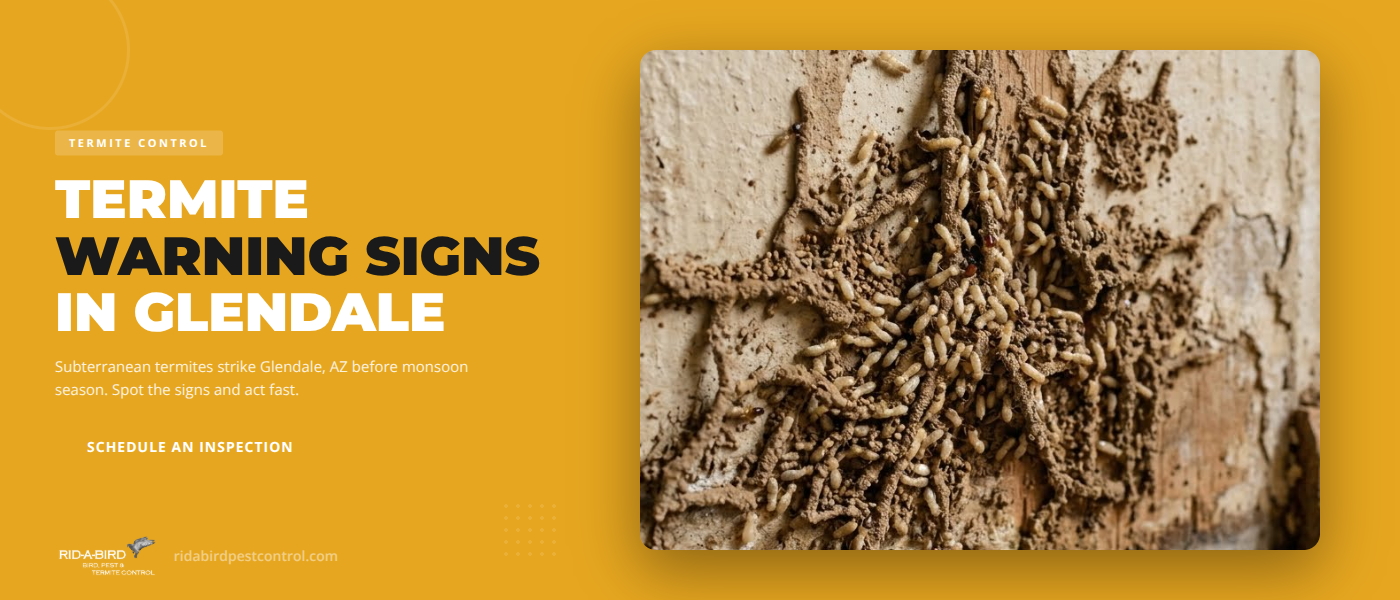
Mud tubes are the most diagnostic sign of subterranean termite activity, and once you know what to look for, they are hard to miss. A mud tube is a narrow tunnel — usually pencil-width, sometimes up to an inch across — built out of soil, wood particles, and saliva. It serves as a climate-controlled highway between the colony in the soil and the wood the workers are feeding on. Without it, workers would dry out within hours of leaving the ground.
In Glendale homes, the most common locations we find mud tubes are:
- Exterior foundation walls and stucco-to-concrete seams — especially on the shaded north side and behind landscape rock
- Garage walls, block perimeter walls, and slab expansion joints — termites readily use these gaps as travel corridors
- Crawl spaces, attic framing, and plumbing penetrations — anywhere wood meets soil, concrete, or moist masonry
- Behind baseboards, around door frames, and at the base of interior walls — interior tubes signal a colony already inside the structure
- Citrus trees, mesquite stumps, and dead palm trunks within 20 feet of the house — yard cellulose often hosts the colony before the home does
If you find a tube and are not sure whether it is active, leave it alone, take a photo, and call for a professional termite inspection. Breaking the tube before our technician arrives scatters the workers and makes pinpointing the colony entry point harder.
Why an Above-Ground Mud Tube Bait Station Works for Glendale Homes
One important note about Rid-a-bird's program: we do not install in-ground bait stations buried around the property perimeter. What we do offer — and what works very well for Glendale homes — is an above-ground mud tube bait station, placed directly on or adjacent to active mud tubes inside garages, block walls, attic framing, and other identified termite travel corridors.
The above-ground approach has several advantages. First, foraging termites are already committed to the tube — placing bait on the active travel route guarantees workers encounter it during routine foraging instead of hunting for a buried station feet away from the actual problem. Second, our technicians monitor the station visually on every service visit and confirm consumption directly, giving Glendale homeowners a clear answer about whether the colony is still active. Third, the station targets the colony through worker-to-colony food sharing — workers carry the bait back, share it with nestmates, and the entire colony declines together over the following weeks.
This approach pairs well with targeted soil treatments when a property has high pressure or known historical activity. For most Glendale homes, the above-ground station combined with a thorough inspection and exclusion work at expansion joints and slab penetrations gives the best long-term outcome — without trenching or drilling around the foundation perimeter.
When to Schedule a Professional Termite Inspection
Some situations move from "watch and learn" to "call our team" right away. Reach out to Rid-a-bird for a Glendale termite inspection if any of the following apply:
- You found mud tubes anywhere on the property — exterior, interior, garage, or attic, active or not
- You discovered a small pile of identical clear wings on a window sill, garage threshold, or near porch lights after a monsoon storm
- The home is more than five years old without a recent termite inspection, or the last one is more than two years old
- You are buying or selling a Glendale home — pre-monsoon is the right time to confirm the property is clear before swarm season
- Neighbors on your block had a recent termite treatment, since desert subterranean colonies regularly extend across multiple adjacent yards
- You see hollow-sounding wood, sticking doors, or pinhole damage in framing, baseboards, or trim
A professional inspection covers the full perimeter, accessible attic and crawl space areas, garage walls, slab expansion joints, plumbing penetrations, and high-risk yard features like citrus trees and woodpiles. We document what we find, walk the homeowner through the evidence on the spot, and recommend treatment only when activity warrants it.
How to Protect Your Home From Termites Year-Round in the Desert
Termite prevention in Glendale is mostly about denying the colony the four things it needs: moisture, cellulose-to-soil contact, hidden entry routes, and shelter. The habits that make the biggest difference:
- Pull wood, cardboard, and stacked landscape materials off the foundation. Keep firewood, mulch piles, and stored lumber at least 20 feet from the house and elevated off the ground.
- Fix irrigation leaks and adjust drip lines. A slow leak against a stucco wall is a year-round invitation. Direct downspouts and irrigation away from the foundation.
- Reduce wood-to-soil contact. Trim fence posts, deck supports, and gate frames so they do not sit in damp soil. Replace any wood trim that has weathered down to ground level.
- Inspect every spring and after major monsoon storms. Walk the perimeter and look for new mud tubes, frass, and shed wings. The earlier we catch activity, the smaller the treatment scope.
- Pair termite monitoring with recurring pest service. A property on a regular general pest control program is one our technicians inspect routinely — and that is when subtle termite signs get caught early.
We serve Glendale along with Phoenix, Peoria, Surprise, Scottsdale, and the rest of the Valley. To schedule a pre-monsoon termite inspection or get on a monitoring program before the first storm, reach our team through the Rid-a-bird termite control page. Pre-monsoon is the difference between catching a colony in its tubes and finding swarmer wings on your kitchen window in August.
Frequently Asked Questions About Termite Signs in Glendale, AZ
What time of year do termites swarm in Glendale, AZ?
Desert subterranean termites in Glendale swarm during monsoon season, typically mid-June through September. Most swarms happen at night after a heavy rain, when humidity is high and the soil is moist. A smaller spring window runs from late March through May. The morning after a storm is when most homeowners find shed wings on window sills and around porch lights.
How can I tell the difference between flying ants and termite swarmers?
Termite alates have two pairs of wings of equal length, straight antennae, and a thick, uniform body. Flying ants have unequal wings (front pair larger than rear), elbowed antennae, and a clearly pinched waist. If the wings are identical and shed in pairs around windows, you are almost certainly looking at termite swarmers — and that warrants an inspection.
Does Rid-a-bird use in-ground termite bait stations?
No. Rid-a-bird does not install in-ground bait stations. We use an above-ground mud tube bait station, placed directly on active termite travel routes inside garages, block walls, and attic framing. Our technicians confirm consumption visually on every visit and target the colony through worker-to-colony food sharing — without trenching or drilling the foundation perimeter.
Does Rid-a-bird offer termite inspections in Glendale, AZ?
Yes. Rid-a-bird provides termite control in Glendale, AZ along with the rest of the Phoenix Valley. Our technicians have worked these neighborhoods since 1991, and we combine pre-monsoon inspections, above-ground mud tube bait stations, targeted treatment, and recurring monitoring through our general pest control program to keep colonies from establishing on Glendale properties.