
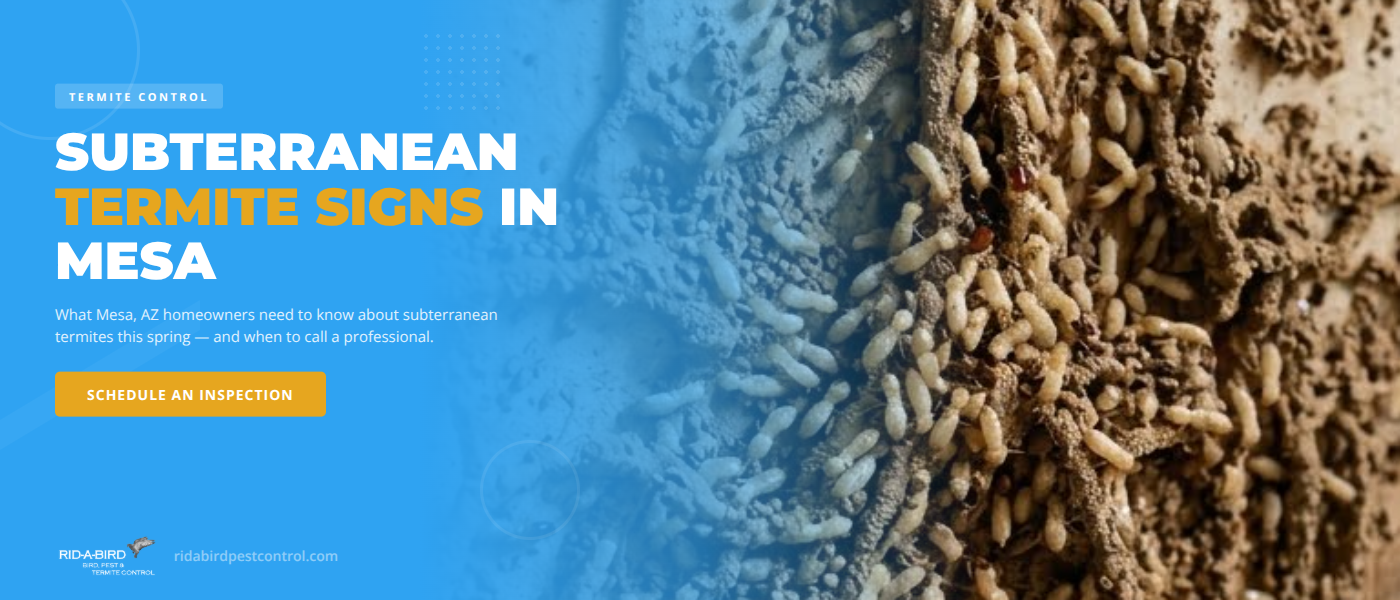
Spring in Mesa, AZ brings warmer temperatures, longer days, and one of the most destructive pest events of the year — subterranean termite swarming. At Rid A Bird Pest and Termite Control, we begin fielding a surge of termite calls from Mesa homeowners starting in March and continuing through May as these wood-destroying insects launch their annual mating flights. If you own a home in Mesa and have never had a termite inspection, or if it has been more than a year since your last one, now is the time to act before hidden damage becomes a costly surprise.
Subterranean termites are the most common and most destructive termite species in Arizona. They live in underground colonies that can contain hundreds of thousands of individuals, and they feed on the cellulose found in wood, paper, and other organic materials inside your home's structure. Because they work from the inside out and avoid light, subterranean termite damage often goes undetected for months or even years. In this guide, we break down the warning signs every Mesa homeowner should recognize, explain why our desert climate creates ideal termite conditions, and share how our professional inspection and treatment process protects your property.
Mesa sits in the heart of the Sonoran Desert, and while many homeowners assume that dry desert conditions would discourage termites, the opposite is true for subterranean species. These termites have adapted remarkably well to Arizona's arid landscape, and several factors specific to Mesa make the area especially prone to infestations:
Regardless of your home's age or neighborhood, subterranean termite pressure is a reality that every Mesa property owner needs to address proactively.
Recognizing the early indicators of a subterranean termite infestation can save you thousands of dollars in structural repair costs. Here are the signs our technicians teach Mesa homeowners to watch for during every inspection:
Mud tubes are the most recognizable sign of subterranean termite activity. These pencil-width tunnels are constructed from soil, termite saliva, and fecal material, and they serve as protected highways that allow termites to travel between their underground colony and the wood inside your home without exposure to air or light.
In Mesa homes, we most commonly find mud tubes in the following locations:
If you find mud tubes on your Mesa property, do not disturb them. Breaking the tubes does not eliminate the colony — it simply forces termites to construct new pathways, and it can make it harder for our technicians to assess the scope of the infestation during a professional inspection.
Every spring, mature subterranean termite colonies in the Mesa area produce winged reproductive termites called swarmers or alates. These swarmers emerge in large numbers — often after a spring rain event or during warm, humid evenings — to mate and establish new colonies. In Mesa, swarming activity typically peaks between March and May, though early-season warmth can trigger swarms as early as February.
Swarmers are often mistaken for flying ants, but there are clear differences. Termite swarmers have straight, beaded antennae, a broad waist, and two pairs of wings that are equal in length. Flying ants have elbowed antennae, a pinched waist, and unequal wing pairs. After mating, swarmers shed their wings, and you may find piles of tiny, translucent wings on windowsills, near doorways, in light fixtures, or on the floor near exterior walls.
Finding swarmers or discarded wings inside your Mesa home is a serious indicator. It means a mature colony is already established either underneath or very near your foundation. We recommend contacting our team immediately if you observe swarming activity indoors.
Subterranean termites consume wood from the inside out, leaving a thin outer shell that may appear completely normal from the surface. One of the simplest detection methods we recommend to Mesa homeowners is tapping on wood surfaces — baseboards, door frames, window trim, and exposed framing in the garage — and listening for a hollow sound. Healthy wood produces a solid, dense tap, while termite-damaged wood sounds papery and thin.
Other wood damage indicators include:
At Rid A Bird Pest and Termite Control, our termite inspection process for Mesa properties is thorough and methodical. We do not rush inspections, because the difference between catching an early-stage infestation and missing one entirely often comes down to checking areas that other companies skip.
Our inspection covers every accessible area of your Mesa home, including:
Following the inspection, we provide a detailed written report of our findings, including the species identified, the location and severity of any activity or damage, and our recommended treatment options. We believe Mesa homeowners deserve complete transparency about the condition of their property before making any treatment decisions.
When our inspection confirms subterranean termite activity on your Mesa property, we offer proven treatment methods that eliminate the current infestation and provide long-term protection against future colonies:
Liquid barrier treatment. We apply a continuous chemical barrier in the soil around your home's foundation. Modern termiticide formulations are non-repellent, meaning termites pass through the treated soil and carry the product back to the colony where it spreads through contact and grooming. This colony transfer effect eliminates entire underground populations.
Termite baiting systems. We install above-ground mud tube bait stations directly on active termite mud tubes. These stations contain a cellulose matrix treated with a slow-acting growth regulator. Foraging termites feed on the bait and share it with nestmates, gradually eliminating the colony. We monitor bait stations on a regular schedule to ensure continued protection.
Localized and spot treatments. When termite activity is confined to a specific area, we apply targeted treatments to address the immediate problem while recommending a comprehensive perimeter treatment to prevent future entry.
Subterranean termite swarming season in Mesa typically runs from March through May, with peak activity occurring in April. Swarms are often triggered by warm temperatures combined with moisture from spring rains or irrigation. However, we have observed early swarms in February during unusually warm winters. If you see flying termites or discarded wings in or around your Mesa home during this period, it indicates a mature colony nearby and you should schedule a professional inspection promptly.
Subterranean termite colonies can consume significant amounts of wood over time. Because they feed inside the wood and avoid exposure, damage can accumulate for years before becoming visible. We have inspected Mesa homes where termites had been active for three to five years before the homeowner noticed any signs. Repair costs in these cases frequently reach $5,000 to $15,000 or more depending on the extent of structural damage. Annual inspections are the most cost-effective way to catch infestations early.
Over-the-counter termite products available at hardware stores are not effective against subterranean termite colonies. These retail products may kill the termites you can see, but they do not reach the underground colony producing thousands of new workers daily. Professional treatment requires specialized equipment for soil injection, knowledge of building construction to identify all entry points, and access to commercial-grade products not available to consumers. We strongly recommend professional treatment for any confirmed subterranean termite infestation.
We recommend annual termite inspections for all Mesa homes, regardless of age or construction type. Properties with a history of termite activity, homes in older Mesa neighborhoods, and properties with extensive landscaping or irrigation should consider inspections every six to twelve months. Many of our Mesa customers incorporate termite monitoring into their regular pest control service plan, which provides year-round oversight without the need to schedule separate inspection appointments.
Yes. Unlike termites in colder states that experience reduced activity during winter months, subterranean termites in Mesa remain active year-round. Our winter temperatures rarely drop below freezing at the soil depths where termite colonies are established, so feeding and tunneling continue through every season. While swarming is a spring event, the damage from an active colony accumulates continuously. This is one of the key reasons we emphasize year-round monitoring and protection for Mesa homeowners.
Subterranean termites are the most significant structural pest threat facing Mesa, AZ homeowners, and the warm desert climate means they never stop feeding. Early detection through professional inspection is the single most effective step you can take to protect your home and avoid costly repairs. At Rid A Bird Pest and Termite Control, we bring over three decades of experience in Arizona termite control to every inspection and treatment we perform. We serve Mesa, Phoenix, Scottsdale, Tempe, and communities throughout the Valley with dependable termite treatment and inspection services.
If you are seeing signs of termite activity or want to schedule your annual inspection, contact Rid A Bird Pest and Termite Control today. We will inspect your Mesa property, explain our findings, and recommend the right treatment plan to keep subterranean termites out of your home.