
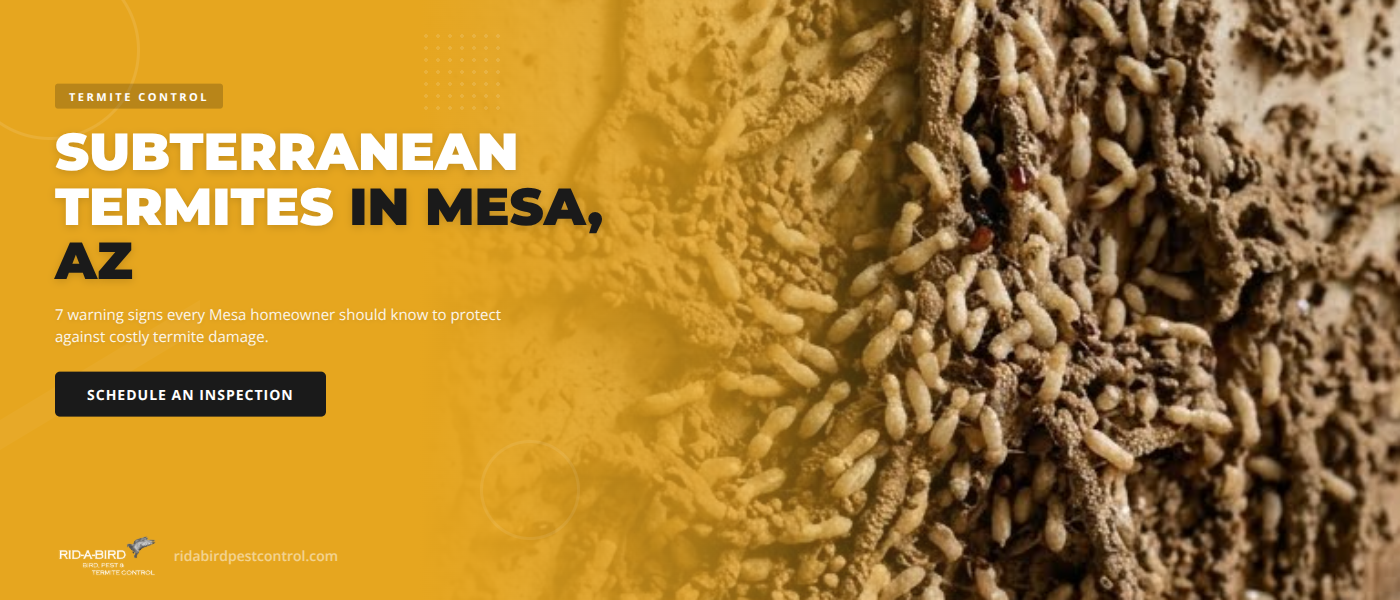
Many homeowners in Mesa, AZ assume that living in the desert means they do not have to worry about termites. Unfortunately, that assumption could not be further from the truth. Subterranean termites are one of the most destructive pests in the entire Phoenix metropolitan area, and Mesa sits squarely in a high-risk zone. These wood-destroying insects cause billions of dollars in property damage nationwide every year, and Arizona homes are among the most frequently targeted due to our warm climate, irrigated landscapes, and construction methods.
At Rid A Bird Pest and Termite Control, we have inspected and treated countless Mesa properties for subterranean termite infestations. In this guide, we will explain the warning signs every Mesa homeowner should recognize, why desert conditions actually favor termite activity, and what steps you can take to protect your property from costly damage.
Why Subterranean Termites Thrive in Mesa, AZ
It might seem counterintuitive that termites could flourish in the arid Sonoran Desert, but subterranean termites have evolved specifically to exploit the conditions found throughout the East Valley. Understanding why Mesa is such a hotspot for termite activity helps explain why vigilance is so important.
The desert subterranean termite, scientifically known as Heterotermes aureus, is the most prevalent and destructive termite species in the Mesa area. These termites build their colonies deep in the soil where moisture levels remain relatively stable even during the driest months. They construct elaborate mud tube networks that allow them to travel between their underground nests and above-ground food sources without being exposed to the harsh desert air.
Several factors make Mesa particularly attractive to subterranean termites:
- Irrigated landscaping - The water we pump into our yards and gardens to keep plants alive also creates the subsurface moisture that termites need to survive. Drip irrigation systems, flood irrigation in older neighborhoods, and regular lawn watering all contribute to ideal soil conditions for termite colonies.
- Warm soil temperatures - Mesa's soil remains warm enough for termite activity throughout the entire year. Unlike northern states where frozen ground halts termite movement in winter, our termites never stop foraging.
- Wood-framed construction - While many Mesa homes feature stucco exteriors, the underlying structure typically includes wood framing, roof trusses, and other cellulose-based materials that termites feed on.
- Mature neighborhoods - Many Mesa neighborhoods were built in the 1970s through 1990s, and the original termite pre-treatments applied during construction have long since degraded, leaving homes unprotected.
- Desert vegetation - Dead roots, buried wood debris from cleared native plants, and decomposing landscape timbers all attract subterranean termite colonies to residential areas.
The Seven Warning Signs of Subterranean Termites in Mesa, AZ
Subterranean termites are notoriously difficult to detect because they work from the inside out, often consuming wood for months or even years before visible signs appear. However, there are several telltale indicators that every Mesa homeowner should know how to recognize.
1. Mud Tubes on Foundation Walls
Mud tubes are the single most recognizable sign of subterranean termite activity. These pencil-width tunnels are constructed from soil, wood particles, and termite saliva, and they run vertically along foundation walls, stem walls, pier pads, and other surfaces that connect the ground to your home's structure. Termites build these tubes to maintain a protected, humid pathway between their underground colony and the wood they are feeding on.
In Mesa homes, we most commonly find mud tubes on the interior and exterior of foundation stem walls, inside garages along the base of walls, on concrete block walls in older construction, and on plumbing penetrations where pipes enter the foundation. If you spot even a single mud tube, it indicates an active or recently active colony nearby.
2. Swarmer Activity and Discarded Wings
Termite swarmers are winged reproductive adults that emerge from mature colonies to establish new ones. In Mesa, AZ, swarming events typically occur during the monsoon season from July through September, often triggered by the moisture and humidity that accompany summer storms. You may see swarmers around exterior lighting at night or find piles of discarded wings on windowsills, near doorways, or in spider webs.
Swarmers are often confused with flying ants, but there are key differences. Termite swarmers have straight antennae, equal-length wings, and a broad waist, while flying ants have elbowed antennae, unequal wing lengths, and a pinched waist. If you find winged insects or piles of wings around your Mesa home during monsoon season, contact us for an identification and inspection.
3. Hollow-Sounding Wood
When subterranean termites feed on structural wood, they consume it from the inside, leaving a thin outer shell intact. This means a door frame, baseboard, or window trim can look perfectly normal on the surface while being completely hollowed out inside. Tap suspected areas with the handle of a screwdriver. Solid wood produces a firm, resonant sound. Termite-damaged wood sounds hollow and papery, and it may even crumble under slight pressure.
4. Bubbling or Peeling Paint
Many Mesa homeowners initially mistake this sign for water damage or heat-related paint failure. When termites tunnel beneath painted surfaces, they create air pockets and moisture buildup that causes paint to bubble, blister, or peel. If you notice unexplained paint damage on interior walls, baseboards, or trim, especially in areas near the foundation, termite activity should be investigated as a possible cause.
5. Doors and Windows That Stick
Subterranean termites produce moisture as they feed on wood, which can cause structural elements to swell and warp. If doors or windows in your Mesa home suddenly become difficult to open or close, and you have ruled out settling or monsoon-related humidity changes, termite damage to the surrounding framing could be the cause.
6. Visible Damage to Wood Structures
In advanced infestations, you may notice visible deterioration of exposed wood elements such as fence posts, deck supports, porch railings, or landscape timbers. Termite-damaged wood often has a layered, gallery-like appearance when broken open, with soil and mud deposits visible within the consumed areas. Check any wood that contacts or sits near the ground, as these are the most vulnerable points.
7. Small Pinholes in Drywall or Wood Surfaces
Tiny pinholes in walls, ceilings, or wood trim can indicate that termites have tunneled close to the surface. These exit holes are often accompanied by small amounts of soil or mud material. While each individual hole is small, their presence points to extensive tunneling activity behind the surface.
Where Subterranean Termites Attack Mesa, AZ Homes
Through years of inspecting properties throughout Mesa and the East Valley, we have identified the most common entry points and vulnerable areas in local homes:
- Garage areas - Garages often have expansion joints and small cracks in the concrete slab that provide direct access from the soil to the wood framing above. We find more termite activity in garages than almost any other area of Mesa homes.
- Bath traps and plumbing penetrations - The openings where plumbing pipes pass through the foundation slab create direct pathways from the soil to interior wood. Bathtub traps are a particularly common entry point.
- Exterior stucco-to-foundation junctions - Where stucco meets the foundation stem wall, small gaps can allow termites to enter behind the stucco and access wood framing undetected.
- Patio and porch attachments - Areas where covered patios, pergolas, or porches attach to the main structure often have wood-to-ground contact or minimal clearance that termites exploit.
- Landscape timbers and mulch - Wood landscape borders and thick mulch beds placed against the foundation create moisture and food sources that attract termite colonies directly to your home.
Termite Damage Costs and Insurance in Mesa, AZ
One of the most important things Mesa homeowners should understand is that most standard homeowners insurance policies do not cover termite damage. Insurance companies classify termite damage as a maintenance issue that homeowners are expected to prevent through regular inspections and treatments. This means the financial responsibility for repairs falls entirely on the homeowner.
Termite damage repair costs vary widely depending on the extent of the infestation, but they can easily range from a few thousand dollars for minor repairs to tens of thousands of dollars for significant structural damage. By contrast, the cost of regular termite inspections and preventive treatments is a fraction of what you would pay for major repairs. We consider annual termite inspections to be one of the smartest investments a Mesa homeowner can make.
Professional Termite Inspection and Treatment in Mesa, AZ
When you contact us for a termite inspection, our trained technicians conduct a thorough evaluation of your entire property. We inspect the interior and exterior of your home, the attic space, the garage, all accessible crawl spaces, and the surrounding landscape. We check for active termite activity, conditions conducive to termite infestation, and evidence of previous damage or treatments.
If termite activity is found, we develop a customized treatment plan based on the specific conditions at your property. Our treatment options include:
- Liquid termiticide barriers - We apply professional-grade liquid treatments around the perimeter of your home to create a continuous chemical barrier in the soil that kills termites as they attempt to cross it.
- Termite bait stations - Strategically placed monitoring and bait stations around your property intercept foraging termites and deliver a slow-acting active ingredient that is carried back to the colony, eventually eliminating the entire colony.
- Localized treatments - For active infestations in specific areas, we can apply targeted treatments directly to the affected zones to quickly eliminate the immediate threat.
- Preventive pre-treatments - For new construction or renovation projects, we offer soil pre-treatments that establish long-lasting protection before the structure is completed.
Frequently Asked Questions About Subterranean Termites in Mesa, AZ
How often should Mesa, AZ homeowners get a termite inspection?
We recommend annual termite inspections for all Mesa properties. Because subterranean termites can be active for extended periods before showing visible signs, regular professional inspections catch problems early when treatment is less expensive and less disruptive. If your home has a history of termite activity or is located in an older neighborhood with mature landscaping and irrigation, semi-annual inspections may be appropriate.
Can I treat termites myself with store-bought products?
We strongly advise against DIY termite treatment. Over-the-counter products may kill the termites you can see, but they do not address the underground colony that can contain hundreds of thousands of individuals. Incomplete treatments can actually make the problem worse by causing the colony to split and establish new access points. Professional treatments are specifically designed to reach the colony and provide lasting protection.
What time of year are termites most active in Mesa, AZ?
Subterranean termites in Mesa are active year-round because our soil temperatures never drop low enough to halt their activity. However, swarming events, which make termite presence most visible, typically occur during the monsoon season from July through September. The moisture from monsoon rains triggers reproductive swarms and increases overall colony activity. Do not assume your home is termite-free simply because you have not seen swarmers. These insects can feed on your home for years without producing visible swarms.
Do concrete slab homes in Mesa get termites?
Absolutely. Many homeowners incorrectly believe that a concrete slab foundation provides protection from termites. In reality, subterranean termites routinely enter slab homes through expansion joints, plumbing penetrations, cracks as thin as a credit card, and gaps where the slab meets the stem wall. The vast majority of termite infestations we treat in Mesa occur in slab-on-grade construction.
How long does termite treatment take to work?
Liquid barrier treatments begin killing termites immediately upon contact. Bait station systems work more gradually, typically taking several weeks to several months to eliminate an entire colony, depending on its size. We monitor treated properties regularly to verify that the treatment is achieving full colony elimination and to ensure ongoing protection.
Protect Your Mesa, AZ Home from Subterranean Termites
Subterranean termites are not a matter of "if" but "when" for most Mesa homeowners. The warm desert climate, irrigated landscapes, and wood-framed construction throughout the East Valley create conditions that termites exploit relentlessly. The key to protecting your property is early detection through regular inspections and proactive treatment when activity is found.
Do not wait for visible damage to take action. Contact us today to schedule a comprehensive termite inspection for your Mesa home. We will identify any existing activity, assess your property's risk factors, and recommend the most effective protection plan for your situation.