
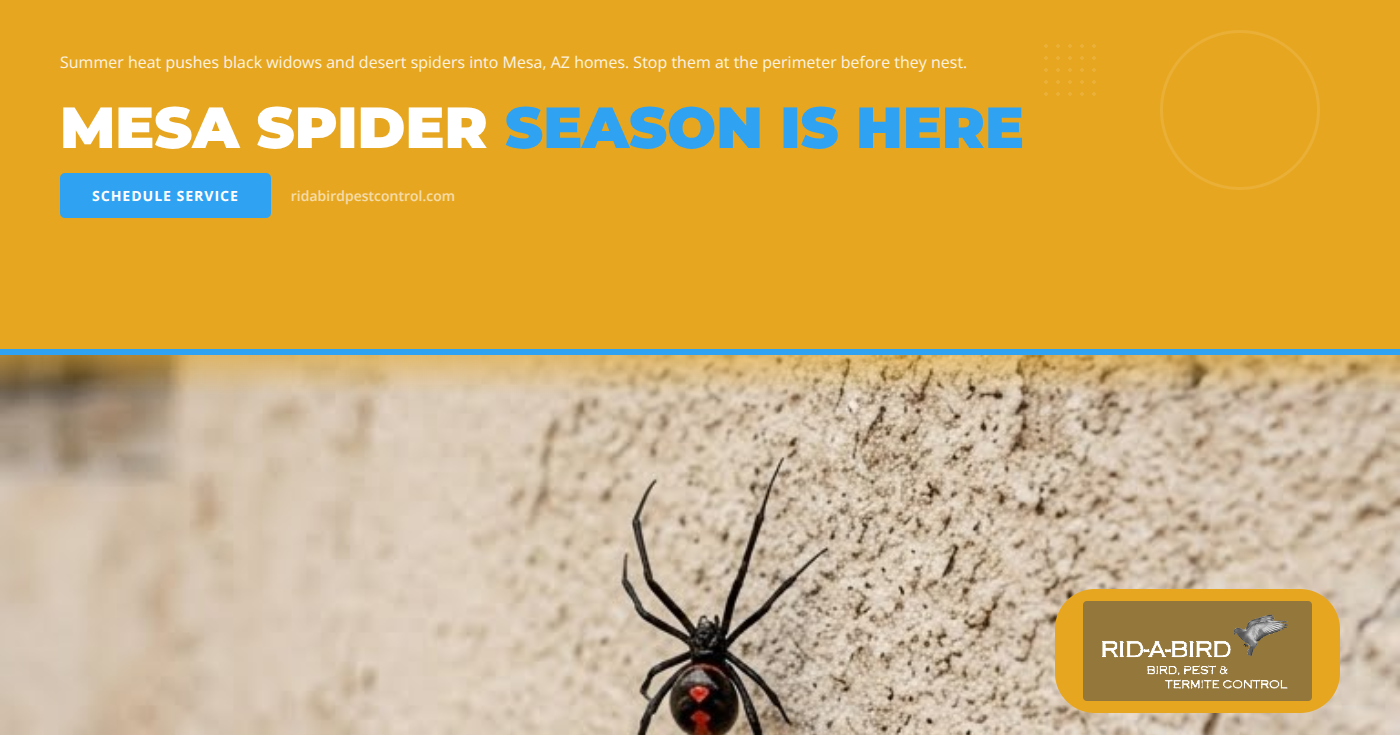
Once the Mesa, AZ thermometer pushes past 105 degrees and overnight lows stop dropping below 80, the spiders that have been living in block walls, irrigation valve boxes, and palm tree skirts start hunting for cooler ground — and that ground is almost always inside your house. Most Mesa homeowners notice the first wolf spider on a bathroom floor in late May or early June, and by mid-July those one-off sightings have turned into nightly encounters. If you are sweeping cobwebs out of the same eave week after week, schedule professional spider control in Mesa, AZ before peak monsoon season pushes the population indoors.
At Rid-a-bird Pest Control, we have served Mesa, Gilbert, Chandler, and the rest of the East Valley since 1991. This guide breaks down why the Mesa spider population spikes from late May through September, which species you will find around an East Valley home, where they hide, the six prevention steps that hold up against monsoon pressure, and when a can of spray stops being enough.
Why Spiders Invade Mesa, AZ Homes Every Summer
Spiders are cold-blooded, and their entire metabolism — hunting range, web building, breeding rate — tracks the outdoor temperature. In Mesa, daytime highs hold above 100 degrees from late May through late September, and overnight lows stay in the mid-80s through most of July and August. That sustained heat does three things at once: it speeds up egg sac development, it dries out the outdoor harborage where they nested all spring, and it pushes them through weep screeds, garage door gaps, and plumbing penetrations toward the cool, humid interior of your home.
The second driver is prey. Spiders follow insects, and Mesa's summer brings an explosion of crickets, cockroaches, moths, and flies. Irrigated lawns, citrus trees, oleander hedges, and pool decking concentrate that prey right against the foundation — and the spiders move in behind it. The first monsoon storms in July make it sharper, flooding storm drains and valve boxes that were sheltering outdoor populations. According to the University of Arizona Cooperative Extension, indoor spider sightings climb sharply through the hottest months because spiders simply follow the food and the cooler temperatures into climate-controlled spaces.
The Most Common Spiders You'll Spot Around Mesa
Five species do almost all of the work in Mesa homes. Knowing which one you are dealing with changes both the risk level and the treatment plan, so our technicians always identify the spider before we propose a program.
- Western black widow — the species every Arizona homeowner should recognize. Adult females are shiny black, about a half-inch in body length, with the unmistakable red hourglass on the underside of the abdomen. They build messy, tangled webs low to the ground in protected spots: pool equipment, irrigation valve boxes, the underside of patio furniture, garage corners, and block wall cavities. The bite is medically significant. The U.S. Centers for Disease Control and Prevention notes that black widow venom is a neurotoxin producing severe muscle cramps, intense radiating pain, sweating, and elevated blood pressure within a few hours — anyone bitten should seek medical care.
- Desert recluse and Arizona brown spider — the closest relatives of the true brown recluse, both native to the Sonoran Desert. We do not have the classic brown recluse in the Phoenix metro, but these two carry similar cytotoxic venom and look nearly identical to the untrained eye: light tan body, long legs, faint violin-shaped mark behind the eyes. They prefer undisturbed storage — boxes in the garage, the back of closets, pool toys in the shed.
- Arizona desert tarantula — large, hairy, slow-moving spiders that show up on Mesa sidewalks during the late-summer mating migration. Males walk for miles looking for females from late July through September. Intimidating but not medically dangerous to most people; the bigger risk is the urticating hairs they kick when threatened.
- Wolf spiders — fast, ground-hunting spiders most Mesa homeowners encounter sprinting across a garage floor at night. Large, brown-and-gray, and do not build webs. Bite is medically minor, but their size and speed make them the spider that scares people the most.
- Common house and cellar spiders — small, long-legged spiders that build loose cobwebs in ceiling corners, around exterior light fixtures, and in shed eaves. Not dangerous, but the constant web building is the most visible sign your home is supporting an active prey population.
If you see a small, shiny black spider in a low garage corner or under patio furniture, treat it as a black widow until proven otherwise. If you find tan, long-legged spiders in storage boxes, that points toward desert recluse — call us before you keep digging.
Where Spiders Hide Inside and Outside Your Home
Spiders need three things: a quiet harborage, a steady prey supply, and access to moisture. Mesa homes give them all three in predictable places. When we run a spider inspection, these are the spots we check first:
- Garage corners, behind the water heater, and along the garage door tracks
- The cabinet under the kitchen sink, laundry room baseboards, and the gap behind the dryer
- Cardboard storage boxes kept on a concrete garage floor
- Pool equipment housings, irrigation valve boxes, and the underside of pool deck furniture
- Block wall cavities, weep screeds, and the gap between stucco and slab
- Outdoor light fixtures, patio ceiling fans, and dark spots beneath the BBQ
- Palm skirts, oleander hedges, and any debris pile within 18 inches of the foundation
The clearest indicators of an active population are persistent webs in the same spot week after week, shed skins on patios and window sills, egg sacs — small papery white or tan spheres — tucked into corners, and dead moths and crickets along the foundation.
Six Prevention Steps to Keep Spiders Out This Summer
The window to harden your Mesa home runs from mid-May to early July, before the first monsoon storms drive both prey and predators indoors. The following six moves work every year:
- Knock down every web you can reach, every week. Sweep eaves, patio ceilings, light fixtures, window frames, and garage corners with a long-handled broom. Constant disturbance pushes spiders to relocate rather than rebuild in the same spot.
- Cut the prey supply. Spiders move in because the cricket, moth, and roach population on your exterior is supporting them. Swap white porch and garage bulbs for amber or yellow LEDs — white light pulls flying insects from a quarter-mile away. Address any active cricket or roach problem first; the spider problem usually follows once the food disappears.
- Seal the building envelope. Replace cracked garage door weatherstripping, install door sweeps on every exterior door, screen weep holes with fine mesh (do not seal them — they need to drain), and foam every visible gap where plumbing, conduit, or HVAC lines pass through exterior walls.
- Pull harborage off the foundation. Move stacked firewood, decorative rock, planters, and cardboard at least 18 inches off the house. Trim palm skirts, oleanders, and citrus branches off the roofline. Tighten the lid on every irrigation valve box in the yard.
- Lock down the garage and storage areas. The garage is the most common spider entry point in Mesa homes. Swap cardboard boxes for sealed plastic totes, get clutter off the floor, and shake out any item that has been sitting undisturbed for more than a season before bringing it inside. Wear gloves when reaching into low storage corners or valve boxes during summer.
- Treat the perimeter on a schedule, not a reaction. A single can of spray after you spot a black widow kills that one spider and nothing else. A maintained exterior perimeter knocks down the prey insects feeding the colony, and the spiders leave for a different yard within a few weeks.
Why DIY Spider Treatments Fall Short in Arizona
Over-the-counter contact sprays kill the spider you can see and do nothing about the egg sac tucked into the eave above it or the dozen more living in the block wall cavity behind the BBQ. Worse, most retail spider sprays repel rather than transfer — meaning the spiders simply move ten feet over, build a new web, and the homeowner is back to square one within a week. The University of Arizona Cooperative Extension and most pest professionals recommend integrated pest management for spiders: prey reduction, exclusion, harborage modification, and a residual exterior perimeter — not broadcast spraying indoors.
The other shortfall is risk. Reaching into a meter box, irrigation valve, or pool equipment housing with a flashlight and a can of spray puts your hand inches from a possible black widow harborage. Our technicians use telescoping wands, vacuum extraction, and targeted residual products in the harborage zones — not a flashlight and a guess.
When to Call a Professional for Spider Control in Mesa
Call us if you see any of the following: more than one black widow on the property in a single week, an egg sac in any spot a child or pet could reach, a tan long-legged spider that could be a desert recluse, webs returning in the same eave within days of being cleared, or any spider activity in a home with someone medically vulnerable. By the time webs are visible on the exterior in multiple spots, the harborage population is established — what you are seeing is the surplus.
Our Mesa spider control service starts with a full interior and exterior inspection. We identify the species, map every harborage point, and document the moisture and prey conditions feeding the population. From there, we vacuum-extract visible webs and egg sacs, run perimeter exclusion at weep screeds and meter boxes, and apply a long-residual product to the harborage zones — block wall cavities, pool equipment, garage thresholds, irrigation valves, and the underside of patio furniture. Quarterly service keeps exterior prey pressure down through monsoon season so the spider pressure never reaches your living space.
We have been treating spider problems across Mesa and the East Valley since 1991, and every program comes with a follow-up window if activity returns between visits.
Frequently Asked Questions About Spider Control in Mesa, AZ
When does spider season start in Mesa, AZ? Activity climbs as soon as overnight lows stop dropping below 70 degrees, which usually happens in late April. The serious push indoors begins once daytime highs hold above 100 in late May, and peak indoor sightings run from mid-June through September, with a second wave of tarantula activity in late summer.
How do I tell a black widow apart from a similar-looking spider? The adult female western black widow is shiny jet-black, about a half-inch in body length, with a bright red hourglass on the underside of the abdomen. The web is messy and tangled rather than orderly, and it is almost always in a low, dark, protected spot — pool equipment, valve box, garage corner. If the spider is brown, striped on the back, or builds an organized circular web, it is not a black widow.
Are the products you use okay around pets and kids? Our technicians use targeted, lower-impact products applied to cracks, voids, and exterior harborage zones — not broadcast sprays on living surfaces. We walk every household through a re-entry window before we start, and we adjust the plan for homes with pets, kids, or sensitivities.
How long until I stop seeing spiders after the first treatment? Most Mesa homeowners see web building and indoor sightings drop sharply within 7 to 14 days. Black widow harborage and desert recluse populations in storage areas may take two to three visits across four to six weeks to fully clear because of the egg cycle. Quarterly service afterward keeps the perimeter pressure down year over year.
Do you service Gilbert, Chandler, and the rest of the East Valley too? Yes. Our Mesa spider control service covers the entire East Valley and most of the Phoenix metro, and our team has been treating Arizona spider problems since 1991. To schedule an inspection, visit our spider pest control page.