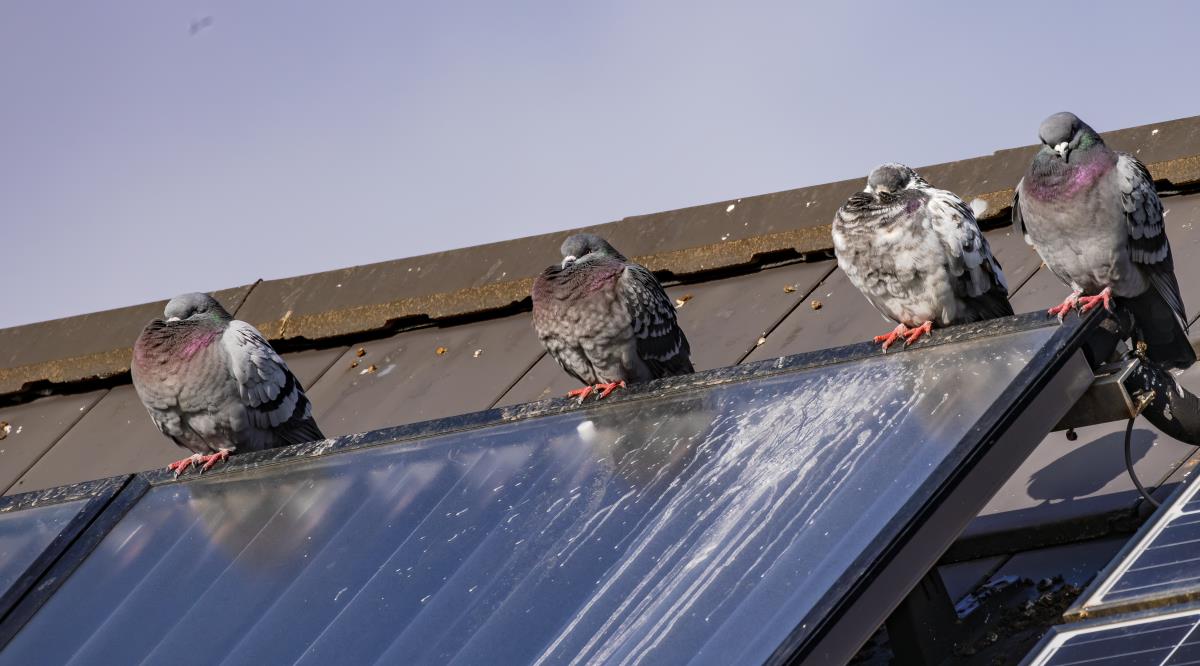
Birds nesting under panels foul wiring, degrade waterproofing, and shade panels — quietly cutting energy output and shortening system lifespan.
Stainless steel mesh installed around panel perimeters — preserves airflow, voids no panel warranties, backed by our lifetime install warranty.
Commercial rooftop solar arrays create the perfect nesting environment for pigeons: warm, sheltered, predator-free, and elevated. Once a flock establishes a roost under your panels, the damage stacks: acidic droppings corrode wiring and roof membrane, nesting material clogs drainage and traps moisture against the roof deck, debris and droppings on the panel undersides reduce ventilation (and panel efficiency drops with operating temperature), and the birds shade panels directly — measurably cutting daily output. For owners and asset managers with multi-MW commercial portfolios, untreated bird pressure on solar arrays can mean 5–15% production loss and accelerated equipment replacement. Rid-A-Bird installs commercial-grade solar panel bird screening that blocks access permanently while preserving the airflow your panels need.
Commercial rooftop arrays leave a 4–10 inch gap between the panel surface and the roof — perfect roosting space. Birds enter through the open perimeter on all four sides of each row. Ground-mount commercial arrays (carports, parking canopies, field installations) have the same problem at a different scale. The fix is the same: a continuous stainless mesh barrier installed around the entire array perimeter, clipped to the panel frame so it never touches the panel surface or interferes with warranty terms.
Cheap plastic mesh from hardware-store solar bird kits fails within 2–3 desert seasons: UV degrades plastic clips, panel-edge attachment loosens, and the mesh sags or rips. Birds find the gap and re-establish the roost. Commercial installations need stainless steel mesh, stainless clips, and an installer who understands rooftop work, fall protection, and how to attach to panel frames without voiding the manufacturer warranty.
Commercial-grade galvanized or 316 stainless mesh sized to your environment. Won't UV-degrade, won't rust, lasts the life of your array.
Stainless clips that attach to the panel frame — never penetrating the panel itself or the roof membrane. Preserves all manufacturer warranties.
Mesh aperture sized for full ventilation. Panels still cool the way they were engineered to, so output stays at spec.
Existing droppings, nesting material, and dead birds removed before screening. Roof and panel undersides pressure-washed and disinfected.
Certified fall protection, tie-off, and lift equipment. We coordinate with your safety team and provide COIs for the install.
If birds breach the screening through a fault in our work, we return and repair at no charge. Warranty documented in the proposal.