
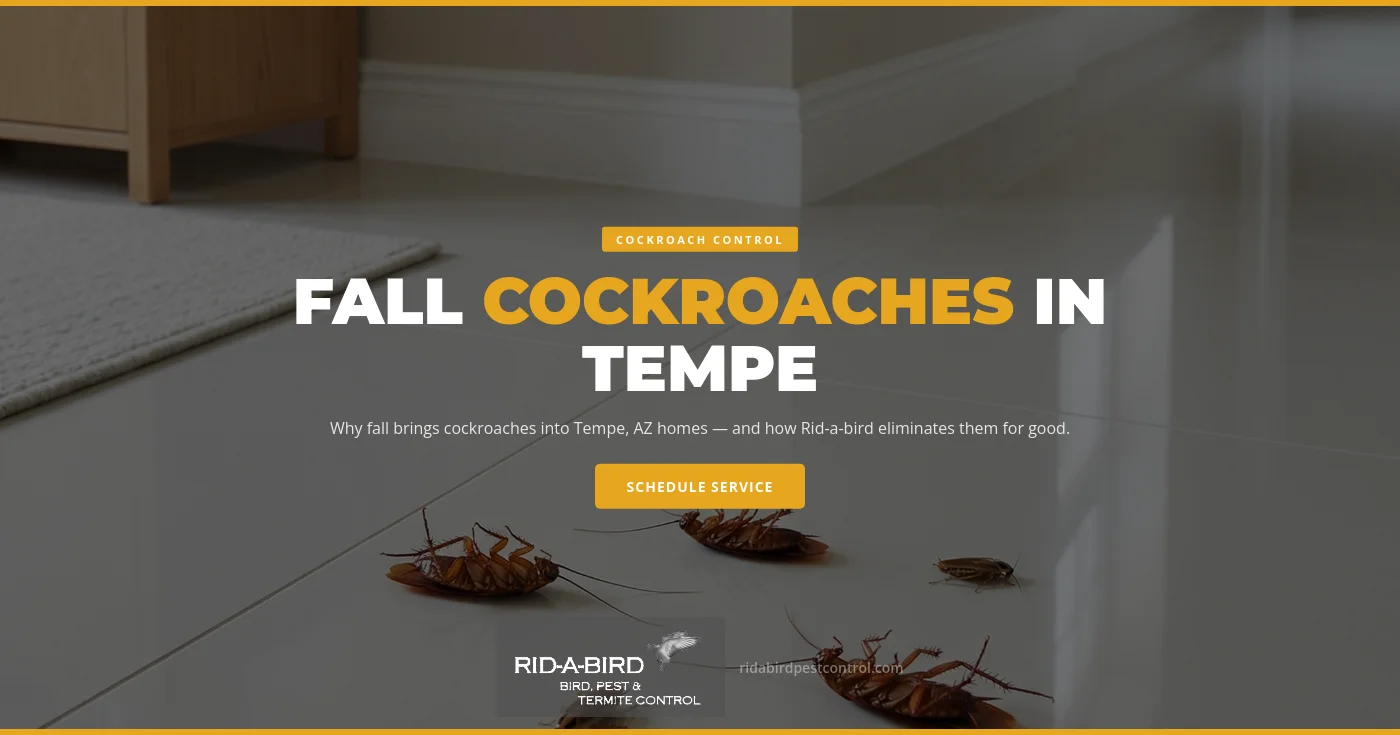
When the dry heat finally breaks in Tempe and mornings slide into the mid-70s, homeowners in Downtown Tempe, South Tempe, and the neighborhoods ringing ASU feel the first stretch of comfortable evenings as pure relief. For our team at Rid-a-bird, that shift is the signal that one of the most predictable pest cycles in the East Valley is about to peak — cockroaches moving indoors in force. Post-monsoon soils around Tempe Town Lake, the canal banks running through the city, and the mature irrigated landscaping that shades older Tempe homes all summer leave behind weeks of lingering moisture, and the drop in overnight temperatures sends outdoor cockroach populations hunting for warmth, water, and food inside kitchens, bathrooms, and garages.
This guide walks Tempe, AZ homeowners through the specific species driving the fall surge, the entry points and harborage sites we find on nearly every service call, the health risks of letting an infestation grow, and the professional treatment process our team runs to clear active populations before they establish in wall voids. If you've already seen the first scout on a kitchen counter at night or found pepper-sized droppings behind an appliance, professional cockroach control in Tempe, AZ catches the problem before it becomes a nightly presence.
Why Tempe, AZ Sees a Cockroach Surge as Summer Heat Fades
From July through mid-September, monsoon storms roll across the East Valley and soak the soils that cockroaches depend on. According to the University of Arizona Cooperative Extension's cockroach reference, Arizona hosts at least five urban species, and the three dominant in the Phoenix metro area — American, Turkestan, and German — all share one biological requirement: constant access to moisture. Monsoon rainfall gives outdoor populations exactly that, and the warm humid stretch is when colony sizes expand the most quickly of the entire year.
What makes fall different is the direction of the pressure. Once overnight lows dip into the sixties and the morning dew lifts, outdoor harborage along canal banks, irrigation boxes, meter vaults, mulch beds, and the wet corners of mature landscape palms stops being comfortable overnight. Cockroaches follow their biology — they move toward stable warmth, reliable water, and food. In Tempe that means slipping under the garage door, climbing a drainpipe into a sink trap, or riding in through a bathroom vent. Our service calls climb in September and October on the same curve every year: outdoor populations that spent monsoon multiplying along the Salt River and the canal network funnel inward through the first cool weeks, and the first sightings almost always come from kitchens near the dishwasher or bathrooms near the shower drain. Fall is the migration window, not the breeding window — which is why early intervention catches the problem while the roach count inside the structure is still small.
The Most Common Cockroach Species Infesting Tempe Homes and Kitchens
Three species account for nearly every cockroach infestation we treat across Tempe, and knowing which one is on the property changes the treatment plan. The German cockroach (Blattella germanica) is the small, light-brown half-inch roach with two dark stripes behind the head. It lives exclusively indoors, breeds inside kitchens and bathrooms, and is the species responsible for most apartment and student-housing infestations near ASU. A single fertilized female can produce several generations in a year, which is how a problem that starts behind a dishwasher reaches every unit on a shared wall in a few months.
The American cockroach (Periplaneta americana) is the large reddish-brown roach homeowners most often call the "palmetto bug" or "sewer roach." According to the Arizona Cooperative Extension community IPM newsletter, this species thrives in sewer systems, storm drains, meter vaults, and the moist leaf litter under mature citrus and palm canopies — all abundant in Tempe. It enters homes through plumbing, drain lines, and gaps around pipes, and shows up most often in bathrooms, laundry rooms, and garages. Adults are nearly two inches long and run fast enough to startle anyone who flips on a kitchen light at 2 a.m.
The Turkestan cockroach (Blatta lateralis) arrived in Arizona in the early 1980s and has largely displaced the Oriental cockroach as the dominant outdoor species in Phoenix. It lives in irrigation boxes, water meter vaults, cracked pavement joints, and dense ground cover. Males are reddish-tan with pale wing margins and are strong fliers that stream toward porch lights after sundown — a sure sign of a nearby outdoor colony that will eventually push foragers indoors through weep screed and door sweeps.
How Cockroaches Enter Your Tempe, AZ Home — and Where They Hide
Cockroaches do not need a wide-open door — they need a gap wider than a dime. Our Tempe inspection checklist starts at ground level and works up. Weep screed and expansion joints on stucco exteriors give American and Turkestan roaches direct access into wall voids. Garage door bottom seals that have cracked in the UV give outdoor species the single easiest entry point into any attached garage. Dryer vents without proper louvers, bathroom exhaust vents on exterior walls, and plumbing cutouts under sinks are consistent entry channels, and so are the drain lines themselves — American cockroaches climb up through floor drains, shower drains, and overflow drains with no trouble at all.
Inside the home the harborage pattern is just as predictable. Behind the refrigerator and dishwasher, under the sink, inside the dark voids of lower cabinet corners, along the gasket of a garbage disposal, inside the motor housing of a microwave, in the gap between the stove and the wall, behind bathroom vanity kickplates, inside the recessed cavity around a bathtub plumbing panel, and in any wall void that stays warm from an interior appliance. German cockroaches prefer tight cracks and the warm electronics behind the fridge; American and Turkestan cockroaches gravitate toward drains, floor-level moisture, and dark storage areas. Garage harborage includes stored cardboard, wine racks, firewood, and dog food bags — anything that sits on concrete and traps moisture underneath. The homes we treat successfully are the ones where every harborage zone gets attention, not just the room where the roaches were first spotted.
Health Risks of a Cockroach Infestation in Your Tempe Property
Cockroach allergens are a recognized asthma trigger, especially for children. Proteins shed in cockroach droppings, saliva, and body fragments accumulate in household dust, and extended exposure sensitizes the lungs of susceptible occupants. The U.S. Environmental Protection Agency lists cockroach allergens alongside dust mites and pet dander as a leading indoor-air trigger, and a landmark urban asthma study in the late 1990s established that children who are both allergic to cockroach allergen and exposed to it at home experience significantly more hospitalizations than peers without that exposure. In high-density student housing near ASU — the garden-style apartments, the mid-rises along Apache Boulevard, and the older rentals in the Marcos de Niza area — cockroach allergen loads can accumulate quickly when a German cockroach infestation runs unchecked across shared walls.
Beyond allergens, cockroaches move through the dirtiest surfaces in a home. They forage in drains, pet food dishes, trash, and sometimes the sewer line itself, and they carry bacteria and pathogens on their legs, bodies, and feces. Our team treats a cockroach infestation as an active indoor-air issue, not just a nuisance. Pulling the population down quickly, decontaminating the harborage zones, and keeping follow-up visits on the calendar for the first year is how a Tempe home moves from allergen-loaded to clean.
Why DIY Cockroach Treatments Often Fail in Arizona
Over-the-counter sprays, foggers, and retail baits rarely clear a desert cockroach infestation, and three factors are responsible. First, pyrethroid resistance in German cockroach populations is well-documented across the United States, meaning the aerosol products on hardware-store shelves kill the slow visible insects and leave the resistant breeders in the wall void untouched. Second, aerosol sprays and foggers scatter the colony — roaches flee the irritant into adjacent cavities and apartments, which spreads the problem instead of concentrating it for treatment. Third, retail gel baits use lower active-ingredient concentrations than the professional-grade formulations we deploy, and most homeowners place bait in the open rather than in the tight cracks where cockroaches actually spend their day.
The Arizona climate adds its own layer. Outdoor American and Turkestan populations along the irrigation boxes and water meter vaults in your Tempe neighborhood keep refilling the indoor pressure through fall. Spraying inside a kitchen does nothing to the breeding colony that lives twenty feet away in a landscape irrigation box, so visible activity returns within weeks. Professional treatment pairs targeted interior gel-bait placement with exterior perimeter work that addresses the outdoor reservoir, which is why our treatments hold and DIY cycles repeat.
How Rid-a-bird Treats and Eliminates Cockroach Infestations in Tempe
Our cockroach service starts with a full property inspection. The technician identifies the species, locates every harborage zone, inspects the drain system, examines the garage and exterior stem walls, and documents entry points. From the inspection we build a treatment plan that fits the specific species — a German cockroach infestation in a kitchen is treated differently than an American cockroach pressure problem riding in through a shower drain, and both are treated differently than a Turkestan population pressing against the exterior of the structure.
Interior treatment uses targeted gel-bait placements in every harborage zone — the cracks behind the refrigerator and dishwasher, inside the lower cabinet voids, under sinks, around the garbage disposal gasket, in the void behind the stove, and inside bathroom vanity cavities. The bait is placed in crack-and-crevice fashion rather than sprayed in the open, which lines up with how cockroaches actually forage and keeps the active ingredient out of reach of pets and children. Exterior treatment addresses irrigation boxes, meter vaults, weep screed, the base of landscape walls, and the areas around dryer vents and plumbing penetrations. Garage treatment covers the door-sweep interface, the perimeter of the slab, and any stored cardboard or soft goods harboring outdoor species that have slipped in.
Follow-up visits are built into every cockroach program. The first follow-up catches the newly hatched egg-case juveniles that any first treatment misses, and subsequent visits track population decline until the harborage zones go cold. Our team has been running this process on Tempe homes since 1991, and 35 years of East Valley experience lives in the follow-up cadence as much as in the inspection.
Keeping Cockroaches Out of Your Tempe, AZ Home for Good
Long-term protection comes from the small structural and habit changes that remove the water, food, and harborage cockroaches require. Fix the slow drip under the kitchen sink, repair the leaking shower valve, replace the cracked garage door bottom seal, add vent louvers on the dryer and bathroom exhausts, and seal the plumbing penetrations under every sink with foam or a plate. Trim ground cover and oleander back off the stem walls so our technicians can see entry points clearly during inspection, and keep landscape mulch pulled an inch or two away from the base of the home. Clear pet food dishes overnight, empty the kitchen trash before bed, and run the garbage disposal with hot water before you turn in. These habits strip the resources that make a kitchen a cockroach destination.
Scheduled quarterly pest service holds the exterior pressure down year-round. The Tempe homes that avoid repeat infestations are on a recurring plan that treats irrigation boxes, meter vaults, and perimeter in April before monsoon starts and again in September as the fall migration window opens. Our team builds every general pest control plan around the specific property — yard size, irrigation layout, garage configuration, and interior history. Between the targeted interior gel-bait work, the exterior perimeter cycle, and the follow-up cadence, our cockroach control in Tempe, AZ delivers the peace of mind that comes from catching the first scout before it becomes a colony. Homeowners ready to clear an active infestation or get on a prevention schedule can reach our team through the site.
When Should I Call a Cockroach Exterminator in Tempe, AZ?
If you're seeing live cockroaches on kitchen counters at night, finding pepper-sized droppings behind the refrigerator or dishwasher, spotting large reddish-brown roaches climbing out of a bathroom or laundry drain, or watching flying male Turkestan roaches stream toward your porch light after sundown, it's time to call a professional. Fall is the peak migration window for cockroaches across Tempe — outdoor American and Turkestan populations that multiplied through monsoon season funnel indoors as overnight temperatures drop, and existing German cockroach infestations in kitchens and bathrooms accelerate their breeding cycles under the humid tail of the season. Our team identifies the species, locates every harborage zone from the kitchen voids to the exterior irrigation boxes, and runs a treatment plan that pairs targeted interior gel-bait placement with exterior perimeter work addressing the outdoor reservoir driving the pressure. Rid-a-bird has served Tempe alongside Phoenix, Scottsdale, Mesa, Chandler, and the rest of the East Valley since 1991, and we'll build cockroach control in Tempe, AZ around the specific entry points, drain system, garage configuration, and interior history on your property.