
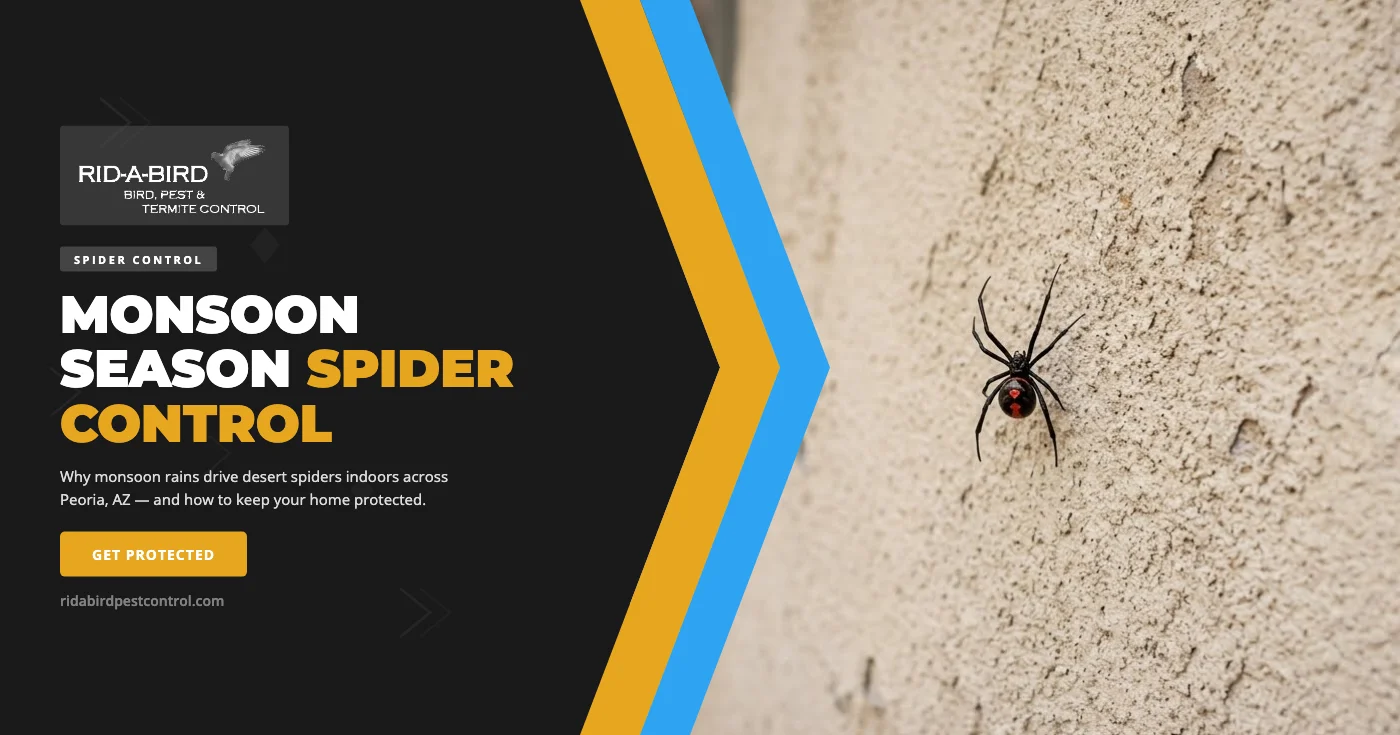
When Arizona's summer monsoon arrives in Peoria, most of us welcome the break from triple-digit dry heat. What we don't welcome are the spiders that suddenly appear in garages, laundry rooms, and hallway corners — sometimes overnight. If you've noticed more webs along your patio or a black widow tucked behind a planter, you're not imagining it. Monsoon season fundamentally changes how desert spiders behave, and Peoria homes sit right in the path of that shift.
At Rid-a-bird Pest Control, we've been handling desert pests across the Phoenix metro since 1991, and every July and August we get the same call from Peoria homeowners: "Why are there suddenly spiders everywhere?" Below we break down what's driving the surge, which spiders matter most, and how professional spider control in Peoria, AZ keeps them out of your home.
Why Spider Activity Rises During Peoria's Monsoon Season
Arizona's North American Monsoon typically runs from mid-June through late September, with peak storm activity in July and August. According to the University of Arizona's Climate Assessment for the Southwest (CLIMAS), these two months alone can account for up to half of Arizona's annual rainfall. For Peoria — sitting on the northwest edge of the Phoenix metro at roughly 1,100 feet — that translates to dramatic humidity swings, sudden dust storms, and the kind of heavy downpours that turn our normally bone-dry desert into a temporary rainforest.
Spiders respond immediately. The extra moisture drives an explosion in insect populations — mosquitoes, flying ants, small beetles — which is exactly the buffet spiders live for. More prey means more spiders, and more spiders means more of them looking for prime real estate, often our homes. On top of that, heavy rain floods burrows, tears down outdoor webs, and disturbs the microclimates where spiders spend most of their lives. When their outdoor world gets scrambled, they migrate to whatever shelter they can find: garages, sheds, block walls, and the gaps around our doors and windows.
Common Spiders Found in Peoria, AZ Homes
Peoria homes see a predictable rotation of spider species during monsoon season. The most common ones our team encounters:
- Western black widow — glossy black with a red hourglass on the underside of the female's abdomen. Prefers dark, undisturbed spots: block walls, meter boxes, garage corners, and stacked patio furniture.
- Arizona brown spider (desert recluse) — tan to light brown, roughly half an inch, with a distinctive violin marking on the head. Native to the Sonoran Desert and often confused with the true brown recluse, which is not established in Arizona.
- Wolf spiders — large, fast, and unnerving to see running across a tile floor. They don't build webs. Instead they hunt at night, and monsoon moisture pushes them toward foundations.
- Desert tarantulas — usually outdoors, but males wander during monsoon looking for mates and occasionally end up on porches or in garages.
- House spiders and cellar spiders — the small, harmless species that leave webs in ceiling corners and window frames. Not medically significant, but a sign your home has a steady insect food supply.
Not every spider you see is dangerous, but two of them — black widow and Arizona brown — carry venom that can cause a serious medical reaction. That's why identification matters before you decide whether to leave a spider alone or call for help.
Are Black Widow Spiders a Concern in Peoria?
Yes — and Peoria's northern-metro geography actually makes them more common here than in denser urban zones. Western black widows thrive in the transition zone between developed neighborhoods and open desert, which describes much of Peoria north of Bell Road, Vistancia, and the areas bordering the Sonoran Desert National Monument.
Female black widows are the ones to worry about — males are much smaller and rarely bite. A female's venom is neurotoxic, meaning it targets the nervous system, and a bite can cause severe muscle pain, cramping, sweating, and elevated blood pressure. Bites are rarely fatal in healthy adults, but children, elderly residents, and anyone with underlying health conditions should get medical evaluation immediately if bitten.
The good news: black widows aren't aggressive. They bite when trapped against skin, which most often happens when someone reaches into a stored box, moves a woodpile, or slides on shoes left in a garage overnight. During monsoon season, when black widows are more likely to shelter in and around structures, the risk of accidental contact goes up. Our team recommends shaking out garden gloves, shoes, and outdoor cushions before use, and using a flashlight when reaching into any dark storage area.
How Monsoon Moisture and Heat Bring Spiders Indoors
Two forces drive spiders inside during Peoria's monsoon: moisture-seeking behavior and heat avoidance. Both peak in July and August, which is why our spider service calls in Peoria roughly double during those months compared to spring.
On the moisture side, spiders don't drink from puddles the way you'd expect. They absorb humidity through their exoskeleton, and even in monsoon season the interior of your home is often more consistently humid than the outdoors — especially in bathrooms, laundry rooms, kitchens, and around leaky irrigation lines. Once a spider finds a steady humidity source with reliable prey (silverfish, cockroaches, small ants), it settles in.
On the heat side, monsoon days routinely push past 105°F in Peoria even during rainy stretches. Spiders that spent spring outdoors in cooler soil temperatures are suddenly hunting for shade. Attics, garages, storage sheds, and the void spaces under roof tiles become premium habitat. From there it's a short trip through gaps around plumbing penetrations, weep holes, and worn weatherstripping into your living space.
Entry points our technicians see most often in Peoria homes:
- Gaps around garage doors — bottom seal wear is the #1 offender
- Weep holes in stucco walls left uncovered
- Cracks around exterior door thresholds and window frames
- Unsealed HVAC and plumbing penetrations
- Torn window screens and dryer vent covers
- Gaps under exterior doors where daylight is visible
Signs of a Spider Infestation in Your Home
A stray spider now and then is normal in Peoria — the desert never really stops producing them. But if you're seeing any of the following patterns, you likely have an active infestation that needs professional attention:
- Multiple webs in the same area — especially in garage corners, patio ceilings, or block wall recesses. One web is a spider passing through; five webs means a colony has moved in.
- Egg sacs — small, off-white, papery sacs (often about the size of a pea) attached to webs or tucked into corners. Each sac can contain hundreds of spiderlings.
- Repeated black widow sightings — especially in meter boxes, block walls, garage corners, or around pool equipment. Widows are territorial; if you're seeing them regularly, you have breeding activity nearby.
- Sudden increase in other pests — spiders concentrate where prey is abundant. More cockroaches, silverfish, or ants often precedes a spider surge.
- Bites overnight — waking up with unexplained welts, especially in clusters or on parts of skin that were pressed against sheets, warrants a professional inspection.
Our team uses these signals along with a full-perimeter inspection to identify what species is present and where it's living. Different spiders need different treatment approaches, and guessing wrong means the problem persists.
Why DIY Spider Control Falls Short in the Arizona Desert
Big-box store spider sprays and ultrasonic repellers are the two most common DIY approaches Peoria homeowners try before calling us, and both consistently fall short in the desert environment. Here's why.
Off-the-shelf sprays are formulated for contact kill on visible spiders. They evaporate quickly in Arizona's heat, especially on sun-exposed exterior walls, so the residual barrier they promise on the label rarely lasts more than a few days here. Meanwhile, desert spider populations breed continuously through monsoon season. Knocking down the ten spiders you can see does nothing about the fifty egg sacs tucked into your block wall.
Ultrasonic repellers have no meaningful published evidence supporting their effectiveness against spiders, and independent university-run studies have repeatedly shown them to be ineffective on desert arthropods. They're an easy purchase that gives homeowners a false sense of resolution while the actual infestation grows.
DIY exclusion — sealing entry points, trimming vegetation back from walls, cleaning up clutter — is genuinely useful, and every Peoria homeowner should do it. But without treatment that addresses the existing population and the surrounding habitat, exclusion alone can't reverse an active infestation. That's where a professional Peoria spider exterminator earns their cost.
How Rid-a-bird Handles Spider Control in Peoria
Our Peoria spider control program is built around the reality of desert pest pressure — not a generic residential template designed for humid climates. When our technicians arrive at your home, they start with a full perimeter inspection: block walls, garage, roofline, meter boxes, pool equipment, patio furniture, and any outbuildings. We identify which species is present, where they're breeding, and where they're getting in.
Treatment is a targeted combination of habitat reduction, exterior perimeter treatment with products chosen for desert conditions, direct removal of visible spiders and egg sacs, and interior spot treatment where needed. We focus especially on the transition zones where landscape meets structure, because that's where monsoon-driven migrations enter your home.
For homeowners in higher-pressure areas — northern Peoria, homes bordering desert washes, or properties with heavy vegetation — we recommend our recurring service plan. Regular treatments through monsoon season keep the population suppressed before it becomes a problem, and our technicians catch early signs of black widow activity around meter boxes and block walls long before they become a hazard to your family. If you've been dealing with spiders longer than a season, or you've found a black widow near your kids' play area, don't wait for the next storm. Reach out to us for a Peoria spider inspection and we'll build a plan that fits your home and your monsoon-season pest pressure.
Learn more about our full spider pest control services, or explore our comprehensive general pest control program for year-round coverage of all of Peoria's desert pests.