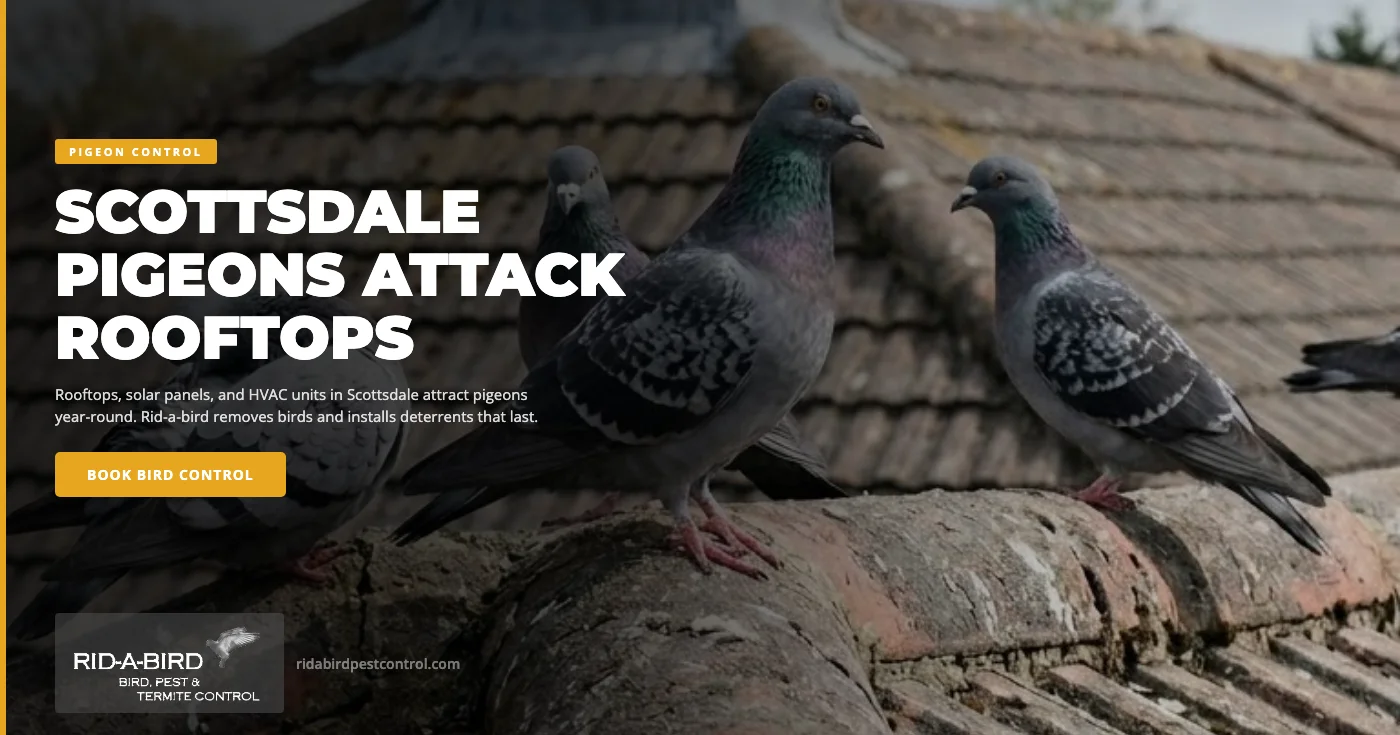
Every fall in Scottsdale, once the monsoon calms and the first cool mornings roll in, our team at Rid-a-bird starts fielding the same call: pigeons on the roof, on the solar array, on the parapet above the entry. Homeowners along Hayden, business owners near Old Town, and property managers running the office parks along the 101 describe the same pattern — a flock that showed up in ones and twos over the summer has quietly turned into a full colony on their building.
We've handled Maricopa County bird work since 1991, and pigeon pressure in Scottsdale follows a pattern more consistent than the weather. Warm year-round temperatures, an unusually rich mix of water sources, and the exact roof geometry these birds prefer combine to make Scottsdale properties some of the most attractive pigeon habitat in the Valley. Below, our team walks through why the pressure builds, what damage to look for, and when pigeon control in Scottsdale, AZ needs to move from DIY to a full professional program before winter.
Why Scottsdale's Desert Architecture Makes It a Prime Pigeon Roosting Zone
Feral pigeons descend from cliff-nesting rock doves, and the buildings that dominate Scottsdale — terraced clay-tile roofs, stucco parapets, mission-style ledges, deep eaves, open patio structures — read to a pigeon exactly the way a cliff face reads to its wild ancestors. A rooftop tile hip in North Scottsdale offers the same shelter, wind protection, and elevation as the rocky outcroppings pigeons evolved to nest on, and once a pair establishes a roost site, they return for years.
The desert climate removes almost every natural check on population growth. According to the University of Arizona Cooperative Extension, feral pigeons in Arizona can produce five to six clutches per year — nearly double the rate of pigeons in colder regions — because warm winters never force them into a resting phase. Unlike temperate cities where harsh winters cap flock size, our neighborhoods hand pigeons everything they need to breed continuously.
Water is the other overlooked driver. Scottsdale properties concentrate more standing water per acre than almost any other part of the Sonoran Desert — pools, decorative fountains, drip irrigation, misting systems, and commercial cooling towers. To a thirsty pigeon flock, a Scottsdale golf-course community or resort corridor is a permanent oasis, and birds cluster in neighborhoods that reliably supply it. Add block-wall yards that hold humidity and roof edges that stay warm past sunset, and Scottsdale becomes ideal pigeon habitat twelve months out of the year.
The Damage Pigeons Cause to Scottsdale Roofs, Solar Panels, and AC Units
The problem with pigeons is rarely the birds themselves — it's what they leave behind. Pigeon droppings are highly acidic, and in the Scottsdale sun they bake onto whatever surface they land on within hours. That combination of low pH and desert heat turns a manageable roost into a genuine property-damage issue faster than most homeowners realize. The surfaces we see damaged most on Scottsdale bird removal calls line up almost every time:
- Clay and concrete roof tiles — droppings etch the glaze and accelerate spalling around ridge caps and hip lines
- Stucco parapets and wall-tops — uric acid eats into the finish coat, leaving permanent staining repainting alone rarely covers
- Solar panel arrays — droppings shade cells and reduce output, and the sheltered gap under panels becomes a preferred nesting site
- AC condenser tops and coil fins — nesting material clogs airflow and droppings corrode aluminum; rooftop package units can lose 10 to 20 percent efficiency
- Rain gutters and canales — nesting debris and feathers block drainage, backing water up under tile and into the roof deck
- Attic vents, dryer vents, and B-vent flashings — pigeons enlarge existing openings and take up residence inside, where droppings accumulate on drywall and insulation
- Vehicles, patios, and pool decks — anywhere birds roost above becomes an ongoing cleanup problem below
Health considerations layer on top of the property damage. The Centers for Disease Control and Prevention notes that dried pigeon droppings can harbor Histoplasma capsulatum and Cryptococcus neoformans — two fungal organisms that become airborne when accumulated droppings are disturbed during cleanup, renovation, or roof work. The risk to a homeowner walking past a soiled patio is low, but for anyone cleaning an established roost or working near a heavily used attic space, the exposure is worth taking seriously.
Why Pigeon Roosting Problems in Scottsdale Get Worse Heading Into Winter
A lot of Scottsdale homeowners assume pigeon pressure follows the same seasonal curve as most Arizona pest issues — peak in summer, ease off through winter. Pigeon behavior runs almost the opposite direction. Our call log at Rid-a-bird consistently spikes from October through February, and there are three reasons every property owner heading into fall should know about.
The first is population math. Every summer clutch matures into breeding adults within four to six months, so the birds on a Scottsdale roof in November are the offspring of the pair that showed up in April. What looked like a manageable presence in monsoon season compounds into a full colony by snowbird season, and colonies of thirty to a hundred birds are common on commercial properties across South Scottsdale and along Shea by the time cool weather arrives.
The second is seasonal food and visibility. Landscaping crews trim date palms and clean up ornamental fruit trees in late fall, and dropped seeds and palm fibers become concentrated ground forage at the same moment resort feeders and outdoor dining patios pick up winter traffic. Meanwhile, summer haze, monsoon dust, and heat shimmer hide a lot of roof activity from ground level — so when the air clears in October, homeowners suddenly see the staining on the parapet and the droppings on the driveway. Waiting until January to schedule bird removal Scottsdale Arizona property owners often need means letting the flock go through one more breeding cycle before deterrents go up.
Warning Signs You Have a Pigeon Problem on Your Scottsdale Property
Pigeons are creatures of habit, and by the time a flock has selected a Scottsdale roof, they leave a consistent trail of evidence long before the population becomes obvious from the street. Every month a roost operates unaddressed is another generation of birds treating the property as home base. The warning signs we tell Scottsdale clients to watch for:
- Cooing at dawn and dusk from the roofline, attic, or under the eaves — subtle but persistent, and it points to established nesting rather than casual perching
- White or gray droppings on the driveway, pool deck, or patio furniture directly below eaves, parapets, or solar arrays
- Feathers in gutters, around downspout heads, or along tile roof valleys — a small pile means one bird, a steady stream means a colony
- Twig, straw, or palm-fiber nesting material tucked into vent openings, behind roof-mounted equipment, or under the leading edge of solar panels
- Repeated bird traffic circling the building at the same times each day, especially mid-morning and late-afternoon fly-outs to water and food
- Staining streaks on stucco below ledges and parapet tops, often with a green or gray cast where droppings have run during monsoon rain
- An AC condenser or attic vent that no longer sounds right, or a sudden drop in solar output that doesn't track with weather or sun angle
- Increased ant, fly, or bird-mite activity around the perimeter — every pigeon roost draws secondary pests that feed on nesting debris and abandoned eggs
Any one on its own may not warrant a service call. Two or three together — cooing plus droppings plus nesting material — almost always indicates an established roost already producing new birds. The Scottsdale properties we get to early spend a fraction of what the ones waiting until visible colony formation end up paying.
How Rid-a-bird Removes and Deters Pigeons From Scottsdale Homes and Businesses
Effective pigeon control in Scottsdale, AZ is not one product or one visit. Our team builds every removal program around three phases that work together: eliminate the current population and nesting sites, exclude birds from the surfaces they were using, and remove the food and water attractants that pulled them in to begin with. Skip any one phase and the flock rebuilds within a season.
Phase one is inspection and roost removal. Our technicians walk the full roof, attic access points, solar arrays, and equipment platforms to map every active nest, egg cluster, and fecal accumulation. Nests come out under appropriate protective protocols, droppings get treated to reduce fungal spore exposure, and surfaces get sanitized. On heavier roosts, we may recommend a short trapping window to reduce the resident adult population before exclusion goes in — a step that dramatically improves outcomes on colonies over 25 birds.
Phase two is exclusion — the physical barriers that make previously-used roost surfaces unusable. For Scottsdale properties, our team specifies the option that fits the surface: stainless bird spike on parapets and narrow ledges, tensioned bird wire on longer straight runs, heavy-duty netting on courtyard voids and commercial atria, and purpose-built solar panel skirts that seal the gap between panel and roof. Solar exclusion has become one of the most-requested services we run in Scottsdale, and the difference in output on a protected array compared to one hosting a pigeon roost is easy to see on a solar monitor.
Phase three is habitat modification. Our team documents the food and water sources on and near the property, then gives homeowners a plain-English plan for what can be removed and what can be managed. On commercial accounts, we coordinate with landscaping and facilities crews on trash-enclosure timing, patio cleanup, and irrigation adjustments — the pigeon deterrent Scottsdale AZ residents most often overlook. A well-executed three-phase program takes a property from active infestation to bird-free within a single service window, and follow-up visits keep it that way.
Long-Term Pigeon Prevention Methods That Work in the Arizona Desert
Getting rid of pigeons is the first job; keeping them off is the discipline. The Scottsdale properties that stay bird-free year after year treat exclusion and habitat management as ongoing building upkeep — the same way they treat HVAC service or roof inspection. Our team runs an annual maintenance program for exactly that, and the methods below are the ones we've found most durable in Arizona desert conditions over three-plus decades.
Physical exclusion holds up longest when specified for the surface. UV-stabilized polypropylene netting outlasts nylon in the Scottsdale sun; stainless steel spike outlasts plastic; tensioned wire outlasts adhesive gels on tile roof lines. Solar panel skirts should be aluminum or heavy PVC with hardware cloth — pigeons chew through soft mesh within a monsoon season. On commercial roof-top units, add coil-fin cages before nesting; retrofitting exclusion around an active roost costs significantly more than protecting an unmarked unit.
Removing attractants is the piece homeowners have the most control over. Trimming date palms and ornamental fruit trees ahead of ripening cuts a significant fall food source. Keeping pool covers taut and reducing standing water in unused fountains removes the reservoirs that anchor a flock. Consolidating outdoor pet feeding indoors eliminates one of the reliable draws in residential neighborhoods. And on multi-family and HOA properties, coordinating trash-enclosure lids, dumpster schedules, and courtyard cleanup materially reduces the bird control Phoenix east valley operators contend with community-wide.
Regular inspection is what ties the program together. Our recurring service on Scottsdale properties includes a full roof and array walk twice a year, with immediate response to any early roost indicators — usually well before homeowners notice from the ground. If pigeons have taken up residence on your roof, solar array, patio, or commercial property, our team is one call away. Reach out through our Pigeon Control service page or connect with Rid-a-bird Pest Control to schedule pigeon control in Scottsdale, AZ that reclaims your building before winter roosting locks the flock in for another year.