
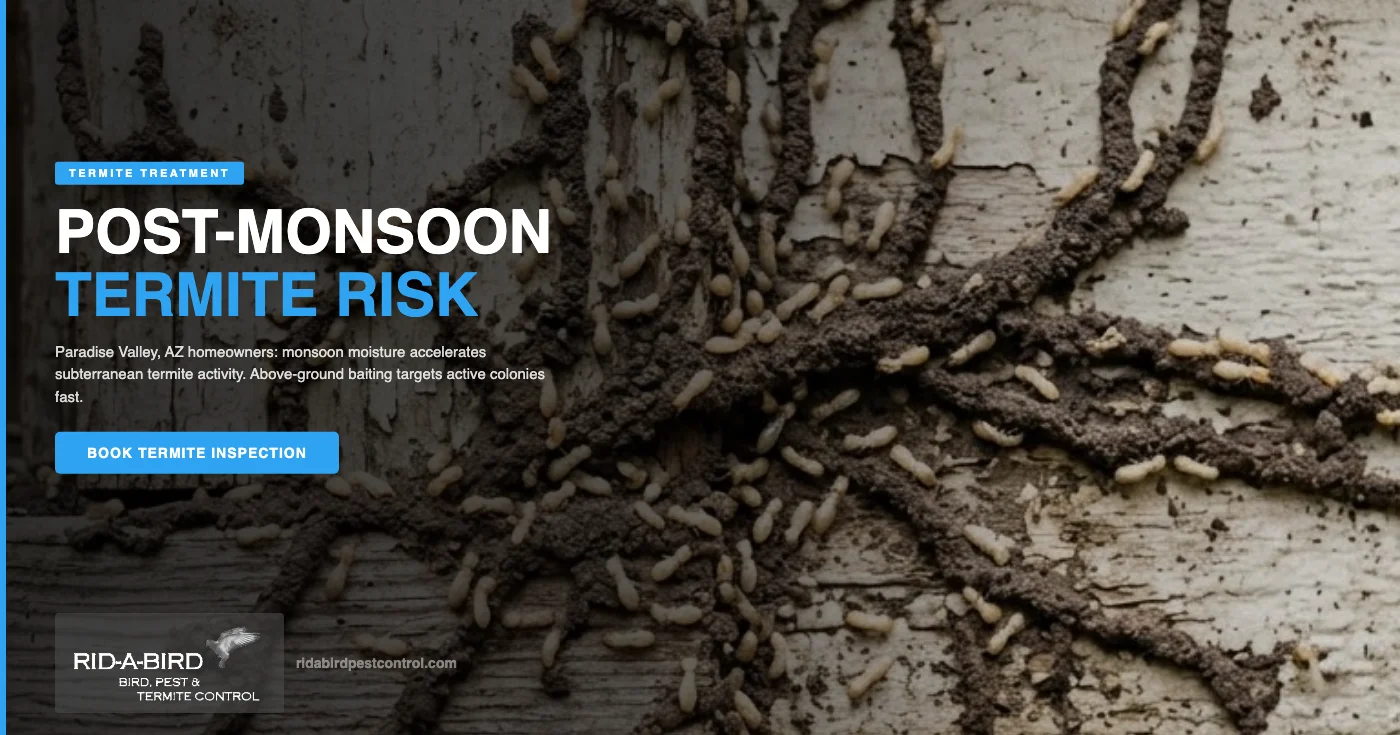
September in Paradise Valley delivers the seasonal shift every luxury-estate owner along Camelback, Mummy Mountain, and the north side of the McDowells notices first — mornings cool enough for a walk, evening lows dropping into the mid-70s, and desert soils still holding weeks of monsoon moisture below the surface. That leftover moisture is exactly what our team at Rid-a-bird watches for every fall. Subterranean termite colonies that spent July and August pushing foraging tunnels deeper into wet soil are now hitting the wettest surface layers of the year, and the properties that get hit hardest are the ones sitting on top of long-established landscaping, mature mesquite groves, and the natural washes that run through the town.
This guide walks Paradise Valley homeowners through why post-monsoon moisture creates the highest termite pressure of the calendar year, the warning signs to catch early, and how our team clears active colonies before damage spreads into the framing. If you're already seeing mud tubes on a stem wall or discarded wings near a window, professional termite treatment in Paradise Valley, AZ is the fastest way to stop the colony before it moves further into the structure.
Why Paradise Valley, AZ Homes Face Elevated Termite Risk After Monsoon Season
According to the University of Arizona Cooperative Extension, subterranean termites are Arizona's number-one urban pest, and Paradise Valley sits in one of the most active termite corridors in Maricopa County. The town's desert-estate lots are built on soils that hold both the natural drainage from the Phoenix Mountain Preserve to the south and runoff from the McDowells to the northeast. When monsoon storms roll through between July and mid-September, those soils absorb heavy rainfall over a compressed six-to-ten-week window, and the water lingers below the surface long after the storms move on.
Paradise Valley properties compound the moisture problem in three specific ways. Luxury landscaping runs on drip and flood irrigation that keeps mature palms, olive trees, and mesquite alive through summer — soil stays consistently damp against foundation stem walls. Decorative water features, pools, misters, and shaded turf lawns hold pockets that never fully dry. Estate-lot footprints are large enough that a colony foraging from a distant mesquite bosque or wash can reach the main house through a hundred feet of continuously irrigated soil without surfacing. Every one of those conditions gives subterranean termites the water they need to survive the desert year-round, and monsoons top it off.
How Subterranean Termites Exploit Post-Monsoon Soil Moisture in the Valley
The species doing the damage in Paradise Valley is almost always Heterotermes aureus, the desert subterranean termite, described in the Extension's technical reference Arizona Termites of Economic Importance (AZ 1369). This species is endemic to the Sonoran Desert and is built specifically for the boom-and-bust moisture cycles our climate delivers. Colonies live several feet below the surface where soil temperatures stay stable year-round, and they extend narrow foraging tunnels outward from the central nest to reach wood — dead roots, buried mesquite, cactus skeletons, fence posts, mulch, or the framing lumber inside a home.
Post-monsoon is when those foraging tunnels do their most aggressive work. Wet soil is easier to tunnel through than baked summer clay, so colonies push tunnels wider and farther in September than at any other time of year. Wet soil also lets termites survive closer to the surface for longer, which puts them in direct contact with stem walls, patio slabs, planter walls, and any structural wood in ground contact. And post-storm humidity triggers swarms — winged reproductives leaving the parent colony in the evening hours after a monsoon downpour to start new colonies nearby. A single successful pair can establish a colony that reaches a Paradise Valley home within two to three years.
The other detail worth understanding: subterranean termites need continuous contact with soil moisture. They cannot survive extended exposure to dry air. When they need to reach wood above the soil line, they build the mud tubes described below to carry damp soil with them. That biological requirement is what makes the mud tube itself the single most useful diagnostic sign a Paradise Valley homeowner can spot early.
Warning Signs of Termite Activity in Paradise Valley Properties
Termite activity is rarely obvious until damage is well underway, which is why our team teaches every Paradise Valley client to walk their stem walls, garage interiors, and outbuildings during and after monsoon season. The signs we look for are consistent across the town's property types — from historic Judson Studio homes off Mockingbird to the newer builds along Tatum, Lincoln, and Doubletree Ranch:
- Pencil-width mud tubes on exterior stem walls, running vertically from soil up to weep screed, stucco expansion joints, or the underside of siding. Mud tubes are the signature indicator of subterranean termite activity.
- Mud tubes inside the garage, particularly on interior block walls, along the perimeter of the slab, or on the sides of storage cabinets in contact with the floor.
- Piles of discarded wings near window sills, door tracks, and pool decks, typically appearing within a day or two of a monsoon storm. Swarmers shed their wings in the same location once they land.
- Hollow-sounding baseboards or door jambs on exterior-facing walls. Tap along the base of the wall — a change in tone often means termites have hollowed the interior of the wood while leaving the surface intact.
- Sagging or dimpled drywall, small pinholes, or blistering paint on interior walls next to bathrooms and kitchens where plumbing has introduced moisture.
- Damaged fence posts, patio pergolas, or decorative timber in ground contact — early feeding sites that often precede structural attacks on the main residence.
- Weakened landscape timbers, wood mulch showing tunneling, or hollowed dead cactus in low-lying corners of the property where irrigation runoff collects.
A homeowner who sees even one of these signs during the post-monsoon window should schedule an inspection quickly. Colonies mature over multiple seasons, and a mud tube visible on a stem wall in September usually means foragers have already been in contact with the structure for months.
How Rid-a-Bird's Above-Ground Mud Tube Treatment Targets Active Colonies
Our team runs a specific treatment for active subterranean termites in Paradise Valley: an above-the-ground bait station that mounts directly onto the mud tube where the colony is actively foraging. The concept is straightforward. When we find an active mud tube on a stem wall, garage wall, or interior wall, we install a bait station over the tube itself — the foragers walking through that tube encounter the bait matrix on their next trip up, take it back into the colony, and share it through the trophallaxis feeding behavior that keeps the entire colony fed. Colony elimination follows over the next several weeks.
The above-ground approach has three practical advantages for Paradise Valley properties. First, it targets confirmed active foragers rather than hoping to intercept them in random soil locations. Second, it works on the estate-scale lots where soil-based interception would require dozens of ground stations spread across acres of landscaping. Third, it protects the mature ornamentals, olive trees, saguaros, mesquites, and hardscape that Paradise Valley homeowners have often spent decades cultivating — no trenching, no soil injection, no disruption to root systems or drip lines.
Every above-ground treatment starts with locating every active mud tube on the property, marking them, and confirming activity by breaking a small section of the tube and returning in twenty-four hours to see whether the termites have repaired it. Repaired tubes tell us where the bait stations need to go. Our follow-up schedule then tracks colony decline as tubes gradually dry out and stop being repaired.
Why In-Ground Bait Stations Are Not Always the Right Fit for Arizona Properties
We do not install in-ground termite bait stations at Rid-a-bird, and the reason is specific to how Heterotermes aureus behaves in Sonoran Desert soils. In-ground stations rely on foragers finding a cellulose-matrix bait buried in the soil around a structure and returning to the colony to share it. That interception model was developed for humid climates — the Southeast, Gulf Coast, and Mid-Atlantic — where Reticulitermes species run dense, closely-spaced foraging networks year-round.
Desert subterranean termite biology is different. Heterotermes aureus forages in narrow, widely separated tunnels that follow individual moisture sources — a broken drip line here, a wet landscape corner there, a soaked stem wall after a storm. The odds that any given in-ground station lands on an active tunnel are low, and most of the year our surface soils are far too dry for termites to remain active near a buried station. Our above-ground mud tube treatment flips the logic: instead of waiting for termites to find bait we go directly to where the termites already are, and on a property with visible tubes we reach active foragers in days.
What a Termite Treatment Inspection Looks Like at Your Paradise Valley Home
A Rid-a-bird termite inspection is a full property walk designed for the estate-scale properties common in Paradise Valley. Our technician starts at the driveway and works the entire exterior perimeter, examining every stem wall, weep screed, expansion joint, and grade transition for mud tubes and moisture patterns. The exterior walk also covers detached casitas, guest houses, pool cabanas, sheds, and any freestanding structures — buildings that share the same soil moisture as the main house but often get skipped during quick inspections.
Inside the home, we check baseboards on exterior-facing walls, tap along door and window jambs, examine plumbing wall cavities under kitchens and bathrooms, and inspect any wood in direct contact with concrete slabs or block walls. The garage gets particular attention — Paradise Valley garages often store framing lumber, patio furniture, wine racks, and mature landscape timber, all of which are common secondary feeding sites once a colony has established itself. Attic inspections cover the roof-to-wall junction where termites sometimes surface after climbing wall cavities.
Every inspection ends with a written report documenting every mud tube location, damage indicator, and moisture concern we found, along with a photo record the homeowner keeps. If we find active tubes, we present the treatment plan on the same visit. If the property is clean, the report becomes the baseline for future annual inspections — the fastest way to catch a new colony before it reaches structural framing. Homeowners can request that inspection through our termite inspection page.
Protecting Your Paradise Valley Investment From Termite Damage Year-Round
The homeowners who avoid repeat termite pressure in Paradise Valley are the ones who address the moisture and landscape conditions that draw subterranean termites in the first place. Real protection comes from managing what sits against the foundation and how water moves through the property.
Move wood mulch, landscape timber, firewood, and stacked patio furniture at least eighteen inches away from stem walls. Keep drip irrigation emitters aimed away from the foundation and repair broken emitters promptly so water does not pool against block walls. Grade landscape beds so runoff moves away from the house, and clear pooled water from planter beds and pool decks after monsoon storms. Trim dense ground cover, oleander, and lantana back from stem walls so our technicians — and future homeowners walking their own property — can see the walls clearly during inspection. Inside the home, address plumbing leaks quickly and keep bathroom exhaust fans working so wall cavities do not stay damp.
Annual termite inspections give Paradise Valley homeowners the peace of mind that comes from catching activity early. On properties with a history of activity, we recommend a full inspection every twelve months and a quick post-monsoon walk each September. Between our above-ground termite treatment in Paradise Valley, AZ, the estate-focused inspection process, and the follow-up cadence, most properties we serve stay termite-clear year after year without disruption to landscaping or hardscape. Homeowners ready to schedule an inspection or immediate treatment can reach our team through the site, and we will build the visit around the specific stem walls, outbuildings, and irrigation setup on the property.