
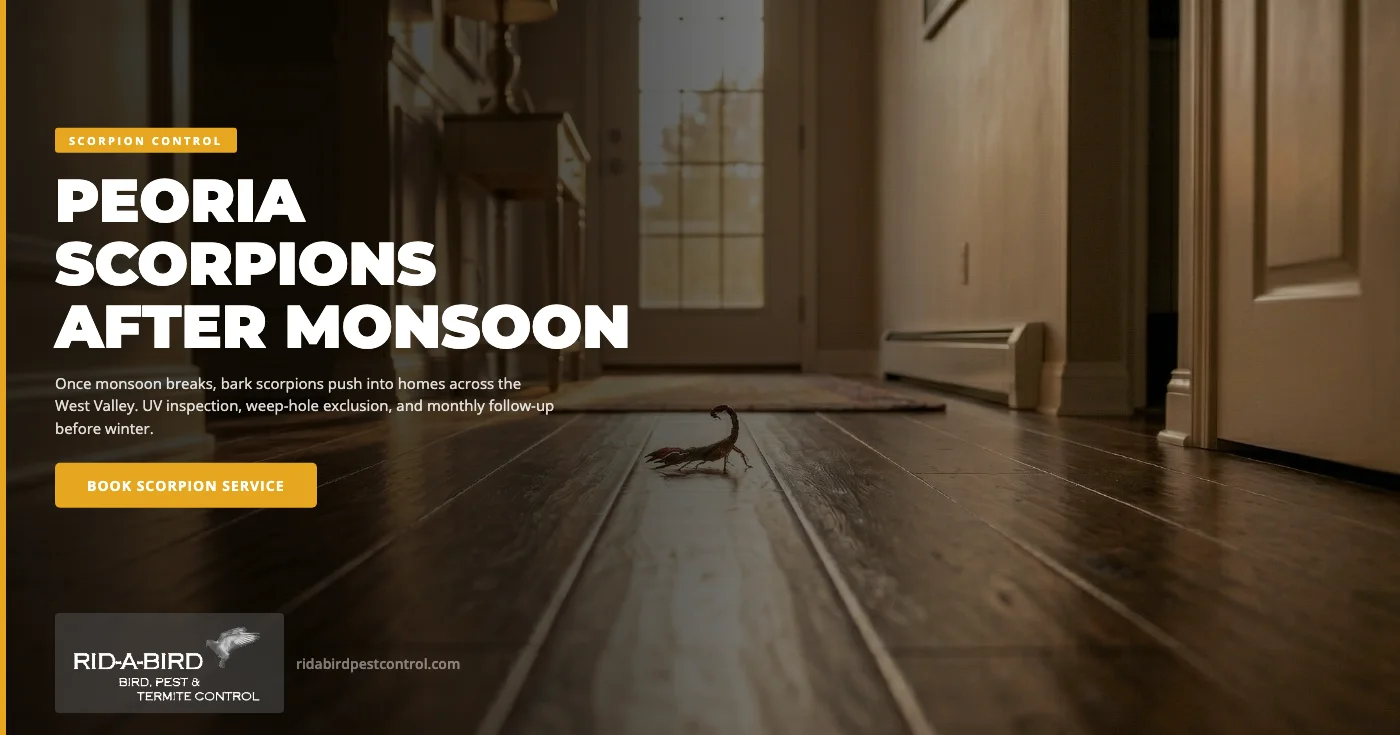
September in Peoria closes out the year's most intense scorpion season with a shift most homeowners feel in the evening air. Daytime highs still push into the mid-90s, but overnight lows finally slip into the low 70s, monsoon storms taper off, and the last three weeks of humidity fade into dry mornings. That transition is the biggest single reason our team at Rid-a-bird sees a surge of scorpion calls from Peoria properties in the weeks after Labor Day. From the Terramar and Vistancia master-plans to the Sunrise Mountain Preserve corridor, out toward Lake Pleasant, and back through the older neighborhoods off Grand Avenue, the September pattern is remarkably consistent — soaked desert soil, displaced insects, and Arizona bark scorpions relocating up out of the desert floor and into any structure that offers cover.
This guide walks Peoria homeowners through why the end of monsoon season triggers indoor scorpion activity, which species are showing up in the West Valley, where they hide, and what a durable prevention program looks like heading into fall and winter. If you have already spotted a scorpion in the garage or found one under a landscape rock, professional scorpion control Peoria AZ service is the fastest way to break the cycle before offspring overwinter inside your walls.
Why Monsoon Season's End Drives Scorpions Into Peoria Homes
Bark scorpions live in the shallow soil, rock crevices, and packrat middens of the Sonoran Desert year-round, but the July and August monsoon transforms that landscape twice. The first change is water. Peoria's monsoon storms drop several inches of rain in short bursts over caliche-hard ground, and the runoff floods every burrow entrance, low crevice, and rock pile where scorpions shelter during the day. Displaced scorpions climb upward onto boulders, up trees, over block walls, and eventually onto porch steps and stucco veneers.
The second change is food. Monsoon rains explode the desert insect population. Crickets, June bugs, and cockroaches complete their life cycles in weeks, moths and mosquitoes swarm at porch lights, and desert termites take flight in the days after the first storm. Scorpions eat all of them. A doubled prey population means a doubled foraging range, and every well-lit Peoria patio becomes a potential feeding ground.
By late September the storms taper off, but the ground stays cool and damp longer than any interior floor. Peoria homes, garages, and pool decks hold residual daytime heat well after sunset, and every crack in the stucco or gap under a garage door pulls scorpions toward the drier, warmer interior. This is when our team fields the highest volume of calls — homeowners who noticed one scorpion in July are suddenly seeing three or four in mid-September, always after dark and always along the same routes.
The temperature curve keeps the pressure on. Bark scorpions remain active as long as nighttime lows stay above roughly 70°F, and in Peoria that stretches well into October. The migration from desert soil to household perimeter is essentially a six-week window, and it opens the week the monsoon breaks.
The Most Common Scorpion Species Found in Peoria, AZ
Three scorpion species show up on Peoria properties, and only one presents a real medical concern. The Arizona bark scorpion (Centruroides sculpturatus) is by far the most commonly reported inside homes. According to the University of Arizona Cooperative Extension, bark scorpions are two to three inches long as adults, with slender pincers and a slender, tapered tail. Coloration varies from pale straw to a mottled tan-and-brown, and a small "subaculear tooth" bump sits on the underside of the tail just below the stinger — a defining identification feature. Unlike other Arizona species, bark scorpions are climbers. They scale block walls, tree trunks, patio umbrellas, and interior walls, which is why they end up in bathtubs, on ceilings, and inside upstairs bedrooms.
The stripe-tailed scorpion (Paravaejovis spinigerus) is a chunkier, ground-dwelling species with thick pincers and a bulky tail. It stays low and prefers rocky ground cover, decorative granite, and the base of block walls. Stings hurt but are not medically dangerous to healthy adults.
The giant desert hairy scorpion (Hadrurus arizonensis) is the largest scorpion in North America — four to six inches long, straw-yellow with dark hairs on the tail. It burrows into open desert soil, ranges most heavily in the country north of Peoria toward Lake Pleasant and the Bradshaw foothills, and rarely enters homes.
The Arizona Department of Health Services notes that only the bark scorpion carries venom potent enough to cause serious symptoms, and the highest risk is to children under six and adults over 65. That single species is the reason a monsoon-season sting call at the Arizona Poison and Drug Information Center still numbers in the thousands every year across Maricopa County.
Where Scorpions Hide Around Your Peoria Property After the Rains
Once the monsoon ends and scorpions begin their outward migration from the desert floor, the hiding spots on Peoria properties are surprisingly consistent. Our inspections turn up scorpions in the same locations year after year, and identifying those spots early is the first step to a durable prevention plan.
Around the exterior of the home, the most common shelters are the base of block walls, expansion joints in concrete patios, gaps under pool coping, the underside of pool equipment pads, garage door tracks, and the wood frames of raised planter boxes. Landscaping features add more cover — piled river rock and decorative granite trap moisture, palo verde and mesquite deadfall creates undisturbed shade, and old packrat middens under prickly pear or cholla can house dozens of scorpions in a single mound.
Structural entry points are typically small. Bark scorpions can squeeze through a gap roughly the width of a credit card. The recurring routes we identify on Peoria homes are gaps under garage doors where the weather seal has cracked in the desert sun, weep holes in the base of stucco or brick veneer walls, the annular openings around AC refrigerant lines and electrical conduit where they pass through exterior walls, cable and satellite conduit chases, and the base of exterior doors with worn thresholds.
Inside the home, scorpions cluster where there is moisture and cover: laundry rooms with floor drains, under bathroom vanities where plumbing penetrates the wall, behind hot water heaters in garages, inside seldom-used shoes and boots in the mudroom, and inside stored towels or bedding in the guest bathroom. Second-story bedrooms are common in older Peoria homes because bark scorpions climb interior walls after entering the first floor and often shelter under sheets and inside closets during daylight hours.
How to Seal Entry Points and Prevent Scorpions From Getting Inside
Entry-point sealing is the single highest-return prevention step homeowners can take before the fall migration peaks in October. Because bark scorpions can pass through a 1/16-inch gap, the goal is not just to eliminate obvious openings but to eliminate every viable gap around the building envelope.
Start at the garage door. The rubber bottom seal on most Peoria garage doors cracks and shrinks within two to three summers of desert sun exposure, and the side jamb seals typically fail before the bottom does. Replacing the bottom seal and both side seals is often the single most effective one-day project a homeowner can complete before October arrives. Move outward from there. Every weep hole in a stucco or block wall should have a stainless steel or copper mesh insert sized at 1/8 inch or smaller — standard rodent mesh is too coarse to stop scorpions.
At every exterior utility penetration — AC refrigerant lines, electrical conduit, cable, gas lines — the gap around the line should be filled with copper mesh backing and sealed with a paintable exterior caulk rated for UV exposure. Screen door bottom sweeps should meet the threshold in full contact. Window screens should be intact with no tears at the frame corners.
Landscape changes matter almost as much as sealing. Pull decorative rock at least twelve inches back from the foundation. Remove wood piles, old landscape timbers, and unused garden pots from within ten feet of the exterior wall. Switch porch lights from white LED bulbs to yellow "bug" LED bulbs — reducing insect prey at the perimeter reduces the reason scorpions congregate near the house in the first place.
Do-It-Yourself vs. Professional Scorpion Treatment in Peoria, AZ
The reason scorpion problems resist over-the-counter treatment is biology. Bark scorpions have exceptionally low metabolic rates — they can survive for six to twelve months without food and are highly resistant to consumer-grade insecticides. Most homeowner sprays either fail to penetrate the scorpion's cuticle or degrade in the Arizona sun before making contact with the target. Interior applications do help reduce nuisance prey insects like crickets and roaches, but they rarely deliver a direct scorpion kill in the field.
Do-it-yourself prevention still has value. UV flashlight patrols after dark help homeowners see live scorpions and locate active runways — under UV, bark scorpions glow bright blue-green and are visible from ten to fifteen feet away. Habit changes matter as well: shaking out shoes before putting them on, keeping laundry off the floor, closing pool equipment lids, and doing a slow perimeter walk with a flashlight before letting children or pets outside after dusk.
Professional scorpion control Peoria AZ service handles the parts DIY cannot reach. Our team at Rid-a-bird has been treating scorpion pressure for West Valley homeowners since 1991, and our fall program combines full property inspection, entry-point sealing recommendations, targeted micro-encapsulated insecticide at scorpion runways, dust products applied in wall voids and attic corners, and a prey-reduction perimeter treatment that suppresses the cricket and roach populations scorpions feed on.
Follow-up cadence matters as much as the initial treatment. Scorpion pressure builds through consecutive weeks, so we schedule monthly service visits through the fall migration and into winter, then step up frequency for the spring emergence in March. If you want to see the full residential program in detail, our scorpion pest control page walks through every step of what we cover on a Peoria property.
Why Fall Scorpion Treatment Protects Your Peoria Family All Winter
Fall treatment is the pivot point of the entire scorpion year. Scorpions in the Sonoran Desert do not truly hibernate — they slow down, cluster in sheltered nesting sites, and remain capable of activity through mild winter nights. Any bark scorpions that establish inside a Peoria structure before the first cold week in December are likely to stay there through spring, feeding on interior prey and, in the case of gravid females, giving birth to a fresh brood of twenty-five to thirty-five juveniles that ride on their mother's back for the first two weeks of life. A single overwintering female inside a wall cavity can seed next year's household population.
That is why the fall service window matters so much for peace of mind. Treating the property before the migration is fully consolidated interrupts the establishment cycle. Sealing, exterior residual treatment, dust in the attic and wall voids, and a suppressed prey population combine to make the interior of the home an unwelcoming environment through the entire dormant window. When spring emergence begins in mid-March, the property is starting from a much lower baseline pressure than an unmaintained neighboring home.
The family piece is the reason we care so much about getting this right. The Arizona Department of Health Services identifies children under six and adults over 65 as the highest-risk groups for serious envenomation symptoms — the exact ages present in most Peoria households with school-age kids or grandparents visiting for the winter. A fall program built around professional scorpion control Peoria AZ standards is the most direct way to keep those household members protected through the season when the pressure is highest. Our team has been serving the West Valley since 1991, and we build every fall scorpion program around the specific landscape, structure, and household priorities of the property in front of us.