
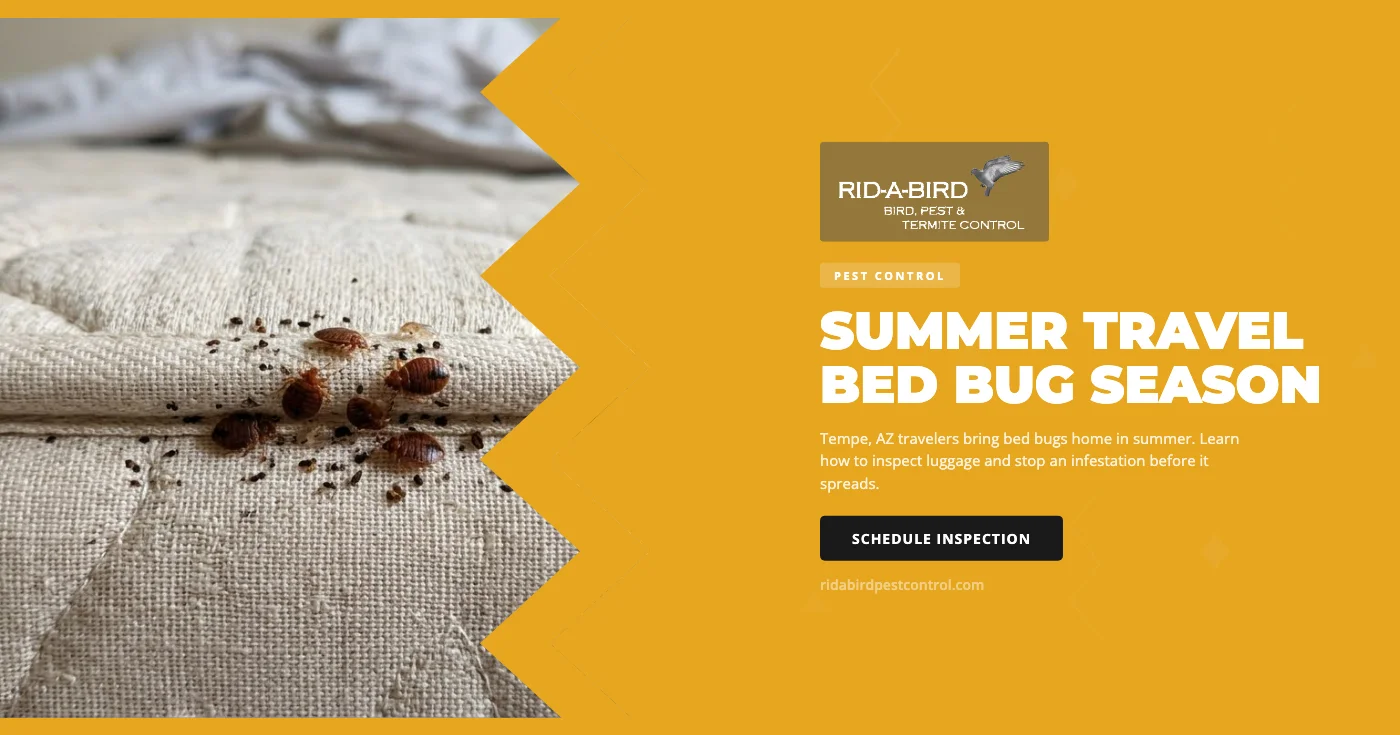
Summer is peak travel season in Tempe, AZ. Sky Harbor is running at full capacity, ASU families are moving in and out of apartments, and residents are returning from vacations across the country. What most travelers don't realize is that summer is also the peak season for bed bug hitchhiking — and the suitcase that just came off the baggage carousel is one of the most common ways bed bugs enter a Tempe home.
At Rid-a-bird, we handle bed bug control in Tempe, AZ and throughout Maricopa County. We consistently see a spike in bed bug service calls from July through September, and the pattern is almost always the same: a family goes on a trip, comes home, and within a few weeks starts noticing bites, blood spots, or dark specks on their mattress. This article walks through why summer travel is so risky, how to inspect your luggage before it ever enters your bedroom, and what to do if you're already seeing warning signs at home. For related pest concerns after travel, our general pest control team can address the broader hitchhiking pests that sometimes come home with luggage.
Why Summer Travel Triggers Bed Bug Infestations in Tempe, AZ
Bed bug populations don't scale evenly across the year. They surge in summer for two overlapping reasons: travel volume and bed bug biology.
Travel volume in Tempe peaks between June and September. Sky Harbor is one of the busiest hubs in the Southwest, and Tempe's dense mix of short-term rentals, hotels, extended-stay properties, and ASU housing means both incoming and outgoing traffic is high. Every hotel room, Airbnb, and rental property visited by a traveler is a potential exposure point. When national bed bug pressure rises during summer travel season, the odds of a Tempe resident encountering bed bugs during a trip climb with it.
Bed bug biology also accelerates in warmer temperatures. Bed bugs reproduce fastest between roughly 75 and 85 degrees — the exact range most air-conditioned homes and hotels maintain year-round. A single fertilized female can lay one to five eggs per day and hundreds over her lifetime. In summer conditions, the full life cycle from egg to adult can complete in as little as five weeks. That means a single hitchhiker brought home in July can become an established infestation by late August if nothing is done.
The Arizona Department of Health Services publishes a bed bug toolkit specifically because Arizona has ongoing residential bed bug pressure — this is not a rare or seasonal-only problem in the state. Summer travel simply amplifies an underlying baseline that already exists in Tempe and the East Valley.
How Bed Bugs Hitchhike From Hotels, Airbnbs, and Rentals
Bed bugs cannot fly and cannot jump. Their only method of long-distance travel is hitchhiking — clinging to fabrics, bags, and belongings that humans carry from one location to another. Understanding how they board your luggage is the first step to keeping them off it.
In a hotel or short-term rental room, bed bugs hide during the day in tight, dark, sheltered spots close to where people sleep. The most common harborage points are mattress seams and tags, box spring corners, headboard crevices, bed frames, wall outlets near beds, baseboards, and — critically for travelers — luggage racks and dresser drawers where guests store bags and clothes overnight.
Bed bugs move onto luggage when it's placed in or near one of these harborage zones. A suitcase on the bed, on the floor beside the bed, or on a luggage rack that already has a hidden bed bug population becomes a vehicle back to your Tempe home. Adult bed bugs can survive weeks to months without feeding, so a bug that boards your suitcase in a Denver hotel or an Orlando rental has no problem surviving the flight home.
Clothing hung in dressers, jackets draped over chairs near the bed, and backpacks or purses set on carpeted floors are all secondary hitchhiking routes. The single biggest reason infestations spread from travel is not carelessness — it's that bed bugs are small, cryptic, and rarely visible to a traveler who doesn't know exactly where and how to look.
Suitcase and Luggage Inspection Steps Before You Bring Bags Inside
The moment your luggage enters your bedroom is the moment an infestation begins. Before that happens, we recommend the following inspection routine every time you return from a trip.
Unpack outside your bedroom. The best location is a garage, driveway, patio, or utility room. Never unpack directly onto your bed, on carpet, or inside your closet. The EPA specifically recommends unpacking directly into a washing machine and storing suitcases away from the bedroom after travel.
Use a flashlight on a hard, light-colored surface. Set the suitcase on a tile floor, a bathtub, or a hard-shell folding table. Bed bugs are reddish-brown and roughly the size of an apple seed as adults; nymphs are smaller and lighter in color. A bright flashlight lets you see them against a light background where dark specks and reddish stains also stand out clearly.
Inspect specific areas. Run the light slowly along every seam, zipper track, and interior pocket. Pull back the lining where possible and examine the corners and the inside base of the case. Check the wheels, telescoping handle base, and exterior straps — bed bugs will use any tight crack or fold as harborage.
Know what you're looking for. Live bed bugs are the most obvious sign, but many travelers see the evidence before they see the bugs themselves. Watch for small dark fecal specks that look like ink dots, reddish-brown smear stains, translucent shed skins that look papery and lighter than live bugs, and tiny white eggs about the size of a pinhead.
Wash and dry all clothing on high heat. Bed bugs and their eggs die at sustained temperatures above roughly 120°F. Washing alone is not reliably lethal — it's the dryer that matters. Run all fabric items on the highest heat setting for at least 30 minutes. For items that cannot be washed, a dryer-only cycle on high heat for the same duration is a common approach.
Treat the suitcase itself. Vacuum the entire interior and exterior of the case, paying particular attention to seams and pockets, then discard the vacuum bag or empty the canister outside. Hard-shell cases can be wiped down with soapy water. Fabric cases benefit from a garment steamer applied along seams. Store the suitcase in the garage, an outdoor storage area, or another location well away from bedrooms — never under a bed or in a closet adjacent to sleeping areas.
Early Signs of a Bed Bug Infestation in Your Tempe Bedroom
If a bed bug made it past your inspection, the earliest signs typically appear within one to three weeks. Catching an infestation at this stage — before the population has spread beyond the primary bedroom — dramatically reduces treatment complexity.
Bites in linear or clustered patterns. Bed bug bites often appear in rows of three or four or in tight clusters on skin exposed during sleep — arms, shoulders, neck, and legs. Individual bites can look similar to mosquito bites but tend to be more concentrated and to appear overnight rather than during outdoor exposure. Not everyone reacts visibly to bed bug bites, so absence of bites does not rule out an infestation.
Dark fecal specks on sheets, mattress seams, and headboards. Bed bug droppings appear as small ink-like dots. They are most concentrated near primary harborage — the seams and tags of the mattress, the piping around box springs, and the underside of headboards. Even before bed bugs are visible, these specks are often the first physical evidence.
Blood spots on sheets. Small reddish or rust-colored smears on sheets and pillowcases come from bed bugs being crushed after feeding or from bite sites bleeding onto fabric.
Shed skins. As bed bugs progress through five nymphal stages, they molt and leave behind translucent, amber-colored exoskeletons that hold the shape of the bug. Shed skins accumulate in harborage areas and are a strong indicator of an active, breeding population.
A musty, sweet odor. Established infestations sometimes produce a distinct smell from bed bug alarm pheromones. If your bedroom smells noticeably different and the smell is concentrated near the bed, that's a reason to investigate closely.
Why DIY Bed Bug Treatments Rarely Work in Arizona Homes
Bed bugs are one of the most difficult household pests to eliminate through do-it-yourself methods. In Arizona homes specifically, several factors combine to make DIY treatment unreliable.
Over-the-counter sprays and foggers target adult bed bugs on exposed surfaces, but they don't penetrate the wall voids, outlet interiors, headboard crevices, box spring cavities, and furniture joints where bed bugs actually spend the majority of their time. Eggs are particularly resistant — most consumer-grade insecticides do not kill bed bug eggs, which means a treatment that appears successful this week produces a new generation of adults within two to three weeks.
DIY heat treatment has become popular but comes with significant risks. Bed bugs require sustained temperatures well above 120°F throughout the entire infested area — not just at the surface. Consumer space heaters, hair dryers, and improvised setups cannot achieve or maintain those temperatures uniformly. There are documented cases of house fires caused by improper DIY heat treatment attempts, and the Arizona summer sun alone — while effective for small items placed outdoors on a hot patio for a full day — cannot address bugs living inside the house where air conditioning keeps interior temperatures well below the lethal threshold.
Steam cleaners can be effective on specific surfaces but require professional-grade equipment to deliver the sustained temperature and pressure needed to penetrate mattress seams and upholstery. Alcohol sprays, essential oils, and diatomaceous earth have limited effect on established populations and generally cannot resolve an active infestation on their own.
The most common outcome of DIY treatment is not elimination — it's dispersal. Repellent sprays cause bed bugs to scatter from the primary bedroom to guest rooms, couches, and adjacent walls, turning a contained bedroom infestation into a whole-home problem that is significantly more expensive and time-consuming to resolve.
When to Call a Professional Bed Bug Exterminator in Tempe
If you're seeing any of the warning signs described above — bites appearing overnight, dark fecal specks on your mattress, blood smears on sheets, or actual bed bugs — the most effective response is a professional inspection followed by targeted treatment. The earlier a bed bug population is addressed, the less extensive and less costly the treatment tends to be.
A professional inspection identifies the extent of the infestation and the specific harborage points involved. Bed bugs behave differently depending on the room configuration, furniture types, and how long the population has been established, which is why a canned treatment approach rarely produces reliable results. At Rid-a-bird, we assess each Tempe property individually and select a treatment approach matched to the specific evidence we find on-site.
We also help travelers who suspect exposure but haven't yet confirmed an infestation. If you returned from a trip and are not sure whether a bed bug came home with you, an inspection can either confirm your home is clear or catch a developing population before it becomes established.
Rid-a-bird serves Tempe and the surrounding Maricopa County communities with residential bed bug inspections and treatment programs designed for Arizona homes. Contact us to schedule an inspection, and if you'd like to see the broader range of services we offer for the pests that sometimes travel home alongside bed bugs, visit our general pest control page.