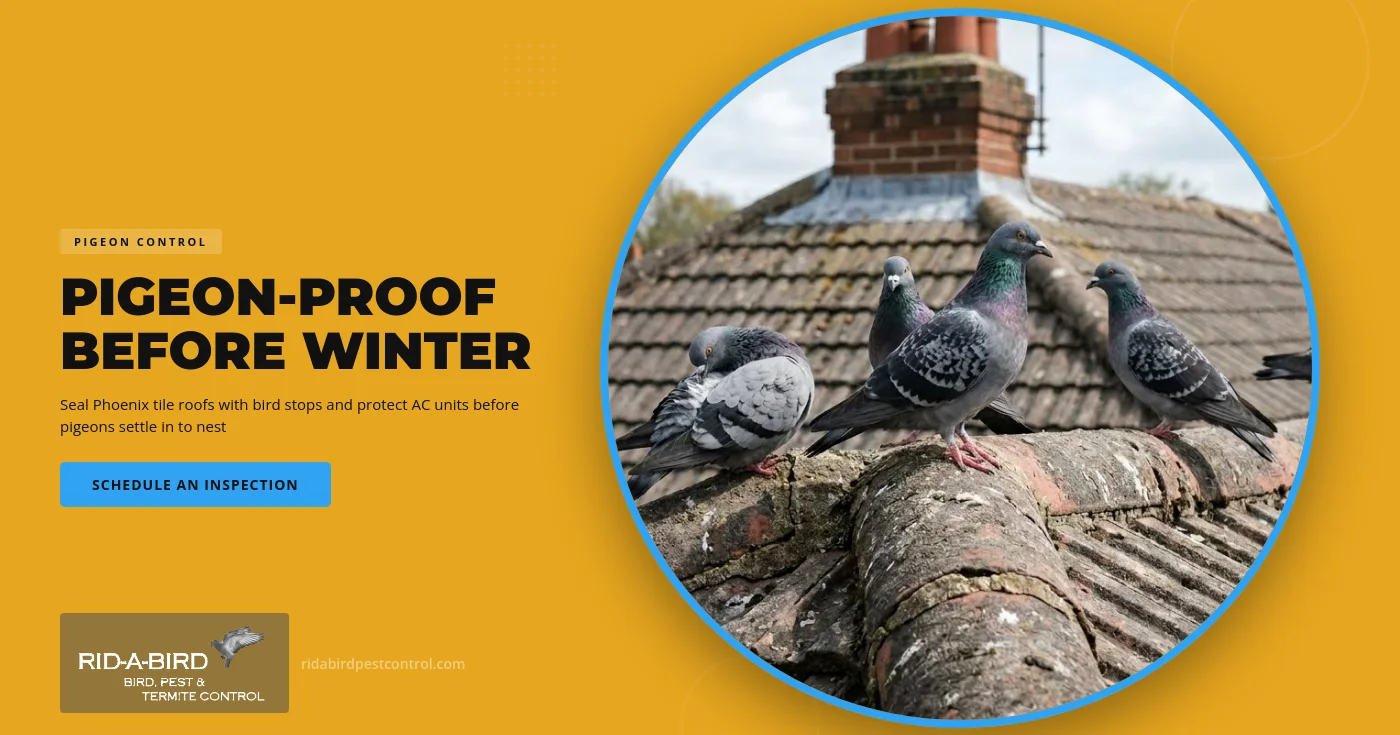
When October finally takes the edge off the heat, you aren’t the only one who notices. Pigeons do too. As roof surfaces cool, the shaded pockets under barrel tiles and the gaps beneath rooftop AC units start looking like ideal winter homes. That makes fall the smartest window for pigeon control Phoenix AZ homeowners can schedule before nesting season ramps up.
Here at Rid-a-bird, we’ve been keeping birds off Valley roofs since 1991, and we see the same pattern every year. Monsoon storms shift and crack tiles over the summer. By the time cooler weather arrives, pigeons are already scouting the new openings, and once a pair claims a spot, they tend to come back again and again.
In this post, we’ll explain why pigeons move onto local roofs in fall, how they get under tile, what they cost you, where they like to roost, and how tile roof bird stops and exclusion keep them out long term.
Why Pigeons Move Onto Phoenix Roofs as October Temperatures Drop
Through the summer, a tile roof in the desert gets hot enough that even pigeons avoid the cavities underneath. They spend those months on shaded ledges, under bridges and in parking structures. October changes the math. Average highs slip from around 90°F early in the month into the 80s, with nights dipping into the 60s, according to the National Weather Service. Roof surfaces stop baking, and the hollow spaces under tiles become comfortable again.
At the same time, nights are getting longer and cooler, so sheltered spots matter more. A cavity under a barrel tile blocks wind, holds a little warmth after sundown and hides a nest from hawks. For a pigeon, it’s close to perfect.
Pigeons don’t migrate, and in a warm climate they can breed all year. The Cornell Lab of Ornithology notes they often raise several broods annually, usually two eggs at a time, with young leaving the nest roughly a month or so after hatching. That means birds that move in this fall may be raising their next generation on your roof by winter. Understanding why pigeons roost on homes here in fall and winter is the first step toward stopping it.
How Pigeons Get Under Barrel and Concrete Tile Roofs
Tile roofs are a big part of the local look, and they hold up well in the heat. Their weak spot is the bottom row. Barrel tiles, also called S-tiles, and many curved concrete profiles leave an open arch where the tile meets the fascia. On a properly finished roof, that opening is plugged with an eave closure, more commonly called a bird stop. On many homes, bird stops were never installed, were fitted loosely, or have cracked and fallen out over the years.
Once that arch is open, a pigeon can walk straight into the channel under the tile. The space runs uphill along the underlayment, giving the bird a long, dry tunnel to fill with twigs. Other entry points we find include:
- Tiles shifted or cracked by monsoon winds
- Gaps where tile meets a stucco wall, parapet or chimney
- Openings around roof vents, solar mounts and satellite dishes
- Ridge and hip lines where mortar has crumbled
Signs of pigeon nesting under roof tiles are usually easy to spot from the ground: twigs or feathers poking out at the eaves, white streaks running down tile and stucco, and cooing early in the morning. If you see birds flying in and out of the same spot, there’s almost certainly a nest behind it.
The Hidden Costs: Droppings, Clogged Gutters, Damaged Underlayment and Health Risks
A few pigeons on the ridge might not seem like much. The trouble is what they leave behind, and how much of it piles up where you can’t see it.
Droppings and staining. Pigeon droppings are acidic and stain tile, stucco, patio furniture and cars. The smell around a heavy roost is hard to miss, and professional pigeon droppings cleanup is often part of the job once birds have been around a while.
Clogged gutters and drainage. Nest debris collects in gutters, scuppers and the channels under tile that carry water off the roof. When monsoon rain arrives, that water has nowhere to go.
Damaged underlayment. Packed nests trap moisture and droppings against the underlayment, the layer that actually keeps water out of your home. Damage there is easy to miss until a stain shows up on a ceiling.
Health concerns. According to the Centers for Disease Control and Prevention, soil contaminated by bird droppings can carry the fungus that causes histoplasmosis, and pigeon droppings have also been linked to cryptococcosis and Salmonella. The risk for healthy people is generally low, but it can rise when large accumulations are disturbed and dust gets into the air. Bird mites from abandoned nests can also wander indoors. That’s one reason we recommend leaving heavy cleanup to a crew with proper protective gear.
Rooftop AC Units, Patio Beams and Other Fall Roosting Hotspots
Tile cavities get most of the attention, but pigeons are opportunists. Anywhere that offers shade, a flat ledge and shelter from wind is fair game this time of year.
Rooftop AC Units
Package AC units are common on flat-roof sections and older homes around town. The gap between the unit and the roof deck is shaded, sheltered and often warm from the equipment. Pigeons nesting on rooftop AC units in Arizona can pack debris around coils and fan housings, while droppings collect on the cabinet and condensate lines. That can mean extra wear and more frequent service calls.
Patio Beams and Ledges
Exposed patio beams, pergola rafters, window ledges and the tops of light fixtures give birds a perfect perch over your outdoor living space. These spots usually show heavy droppings on the furniture or concrete below.
Solar Panels
The gap under rooftop solar panels is another favorite: shaded, protected and hard for predators to reach. We address it with solar panel bird protection that closes off the perimeter of the array.
Businesses face the same problem on a bigger scale, from rooftop equipment to loading docks, which is why we also offer commercial pigeon control for storefronts, warehouses and multi-family properties.
How Rid-a-bird Pigeon-Proofs Tile Roofs With Bird Stops and Exclusion
Fake owls, shiny tape and ultrasonic gadgets are popular, but pigeons get used to them quickly. The University of California Integrated Pest Management program notes that exclusion, physically blocking access to roosting and nesting sites, is generally the most effective long-term approach. That’s the foundation of how we work:
- Roof inspection. We check every eave, ridge, vent and rooftop unit, and identify active nests and entry points.
- Nest check and removal. We confirm which species is nesting. Feral pigeons can be removed, but some native birds are protected, so we never seal in a protected bird’s active nest.
- Cleanup and sanitizing. We clear nest material and droppings from tile channels, gutters and equipment.
- Bird stop installation. We fit tile roof bird stops matched to your tile profile so eave arches are closed while the roof can still breathe and drain.
- Exclusion for other hotspots. We screen gaps under AC units, add mesh around solar arrays and use netting or other deterrents on beams and ledges where needed.
Every home is different, so we tailor the plan to your roof. Our team holds OSHA certification and Arizona state certification in pest and termite work, and we back our bird work with a lifetime warranty. To see the full range of options, visit our residential bird control and removal page.
Why Fall Is Better Than Waiting Until Winter Nesting Season Starts
It’s tempting to wait until you hear cooing over the bedroom. The problem is that by then, birds have already committed to the site. Here’s why we push for fall:
- Fewer active nests. Sealing a roof with eggs or chicks inside isn’t an option, and active nests slow the job. Getting ahead of nesting keeps things simpler.
- Better working conditions. Summer roof surfaces are brutally hot. October and November let our crews work carefully and thoroughly.
- Post-monsoon repairs. Storm damage is still fresh, and fixing loose tiles now closes openings before birds find them.
- Breaking the habit early. Pigeons are loyal to roost sites. The less time they spend on your roof, the easier they are to discourage.
There’s a seasonal angle, too. Many seasonal residents return in October and November to find birds moved in while the house sat quiet all summer. A fall inspection catches the problem before it becomes a winter-long nuisance.
So, what’s the best time to pigeon-proof a roof in Phoenix? For most homes, it’s right now, after the worst heat and before winter nesting picks up.
Frequently Asked Questions About Pigeon Control in Phoenix, AZ
Are pigeons protected in Arizona?
Feral pigeons are non-native and aren’t covered by the federal Migratory Bird Treaty Act. Native birds that also nest on roofs, such as mourning doves, white-winged doves and house finches, are protected, and their active nests generally shouldn’t be disturbed. At Rid-a-bird, we identify the species before any removal begins.
How do I keep pigeons out from under my tile roof in Phoenix?
The most reliable fix is closing the eave openings with properly fitted bird stops and repairing any displaced tiles. Spikes or decoys alone rarely solve the problem, because the birds simply move a few feet over.
Will bird stops damage my roof?
Installed correctly, bird stops sit in the existing eave openings and are designed to let the roof ventilate and drain. If you have questions about your roof’s warranty, check with your roofer, and we’re happy to walk you through the materials we use.
Can I seal the roof myself while the birds are out?
We don’t recommend it. Pigeons often leave eggs or young behind, and sealing them in creates a bigger mess and odor problem. Climbing a tile roof is also risky and can crack tiles. That’s why our approach to pigeon removal Phoenix homeowners rely on always clears nests first and seals second.
Schedule Pigeon Control in Phoenix, AZ Before Winter Nesting
Pigeons are patient. If there’s an open eave or a shaded gap under your AC unit, they’ll find it this fall and keep coming back. Sealing those openings now, before winter nesting gets underway, is the simplest way to protect your roof, your equipment and your outdoor spaces.
Here at Rid-a-bird, we’ve been bird-proofing Phoenix homes and businesses since 1991. Our pigeon control Phoenix AZ service includes a full roof inspection, cleanup, bird stops and exclusion, all backed by our lifetime warranty on bird work, and we proudly offer military discounts. We serve communities across the Valley, from Scottsdale, Tempe and Mesa to Glendale, Peoria and Sun City; see our full list of areas we serve.
Ready to get ahead of nesting season? Contact us today to schedule your roof inspection, and let’s keep pigeons off your roof this winter.
How Can I Keep Pigeons From Nesting Under My Tile Roof This Winter?
Fall is when pigeons start moving into the open gaps under barrel and concrete tiles, and once a pair settles in, they keep coming back. We stop that cycle by closing off the spots they use before winter nesting gets underway.
Here’s what our pigeon-proofing service includes:
- A full roof inspection of eaves, ridges, vents and rooftop AC units
- Nest and droppings cleanup handled by our crew with proper protective gear
- Custom-fit bird stops matched to your tile profile so eave openings stay closed
- Exclusion for other hotspots, including AC units, solar panels and patio beams
We check which species is nesting before any removal, because some native birds are protected. Pigeons are cleared first, then we seal, so nothing gets trapped inside your roof.
We’ve been keeping birds off roofs since 1991, our team holds OSHA certification and Arizona state certification in pest and termite work, and every job we do on birds comes with a lifetime warranty. That means real peace of mind long after our crew climbs down the ladder.
Want the full breakdown of why October is the ideal time to act, what pigeons cost you in damage and how bird stops work? Read our complete guide to fall tile roof pigeon-proofing.